關於 GBIF
|
全球生物多樣性資訊機構(Global Biodiversity Information Facility,GBIF)是一個由各國及各類組織參與組成的國際網絡,致力於促進各類生物多樣性資料的自由與開放存取,並支持生物多樣性科學、環境研究及以證據為基礎的決策制定。 GBIF 以聯邦式架構運作,由分散於各地的資料發布工作所組成,並透過全球資訊基礎設施與協作網絡加以整合與協調。 在本單元中,你將進一步了解 GBIF。 |
什麼是 GBIF?
|
你能夠想像如果我們可以找到、取得並有組織地使用地球上的生物多樣性資料,將能產生多麼龐大的知識量? 這段影片(03:19)https://vimeo.com/236573907 最初由 GBIF 的兩個國家節點——哥倫比亞生物多樣性資訊系統與 GBIF 西班牙節點——以及 Go Visual 共同製作,並由 GBIF Spain 與哥倫比亞亞歷山大·馮·洪堡生物資源研究所(IAvH,SiB Colombia 的主辦機構)共同資助完成。 若你無法觀看內嵌的 Vimeo 影片,可透過 下載 將其下載至本機(MP4 格式 - 39.5 MB)觀看。 |
| 若你在影片上看到 CC 圖示,可以點擊該圖示以開啟英文或其他可用語言的字幕。 |
GBIF 簡介
|
在這段影片(07:40)中,GBIF 公關主管Kyle Copas 將簡要介紹 GBIF,包括我們是什麼樣的組織、我們的工作內容,以及推動這些工作的原因。 若你無法觀看內嵌的 Vimeo 影片,可透過 下載 將其下載至本機(MP4 格式 - 35.8 MB)觀看。 |
Presentation transcript
Click to expand
投影片 1 - GBIF 簡介
大家好!我是 Kyle Copas,目前擔任GBIF公關主管。很高興透過這段簡短的介紹,向各位說明 GBIF 是什麼樣的組織、我們的工作內容,以及我們為何投入這些工作。我希望這段介紹能為你接下來的培訓課程提供一些背景脈絡,並鼓勵你運用在課程中所學到的知識與技能,共同推動 GBIF 的願景:「建立一個以最完善的生物多樣性資料為基礎,支持科學研究、政策制定與各項決策的世界」。
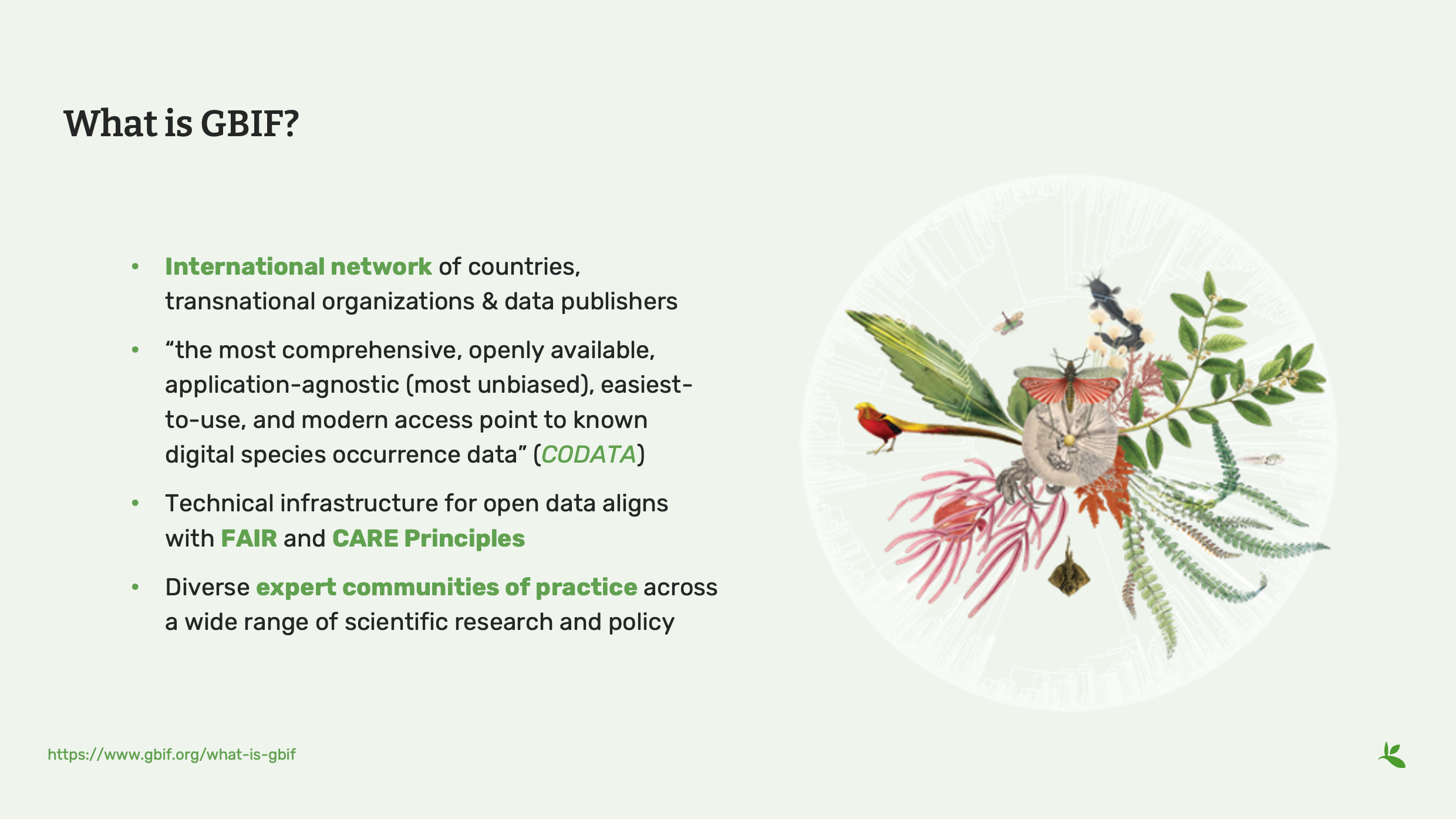
投影片 2 - 什麼是 GBIF?
那麼,GBIF 是什麼?GBIF 是一個國際性的網絡與資料基礎設施,致力於讓全球任何人都能自由、開放地存取地球上所有生命形式的資料。這些資料是開放科學的重要證據的來源,被廣泛用於科學與政策領域,並由全球的專家、合作夥伴與協作者社群共同支持與推動。
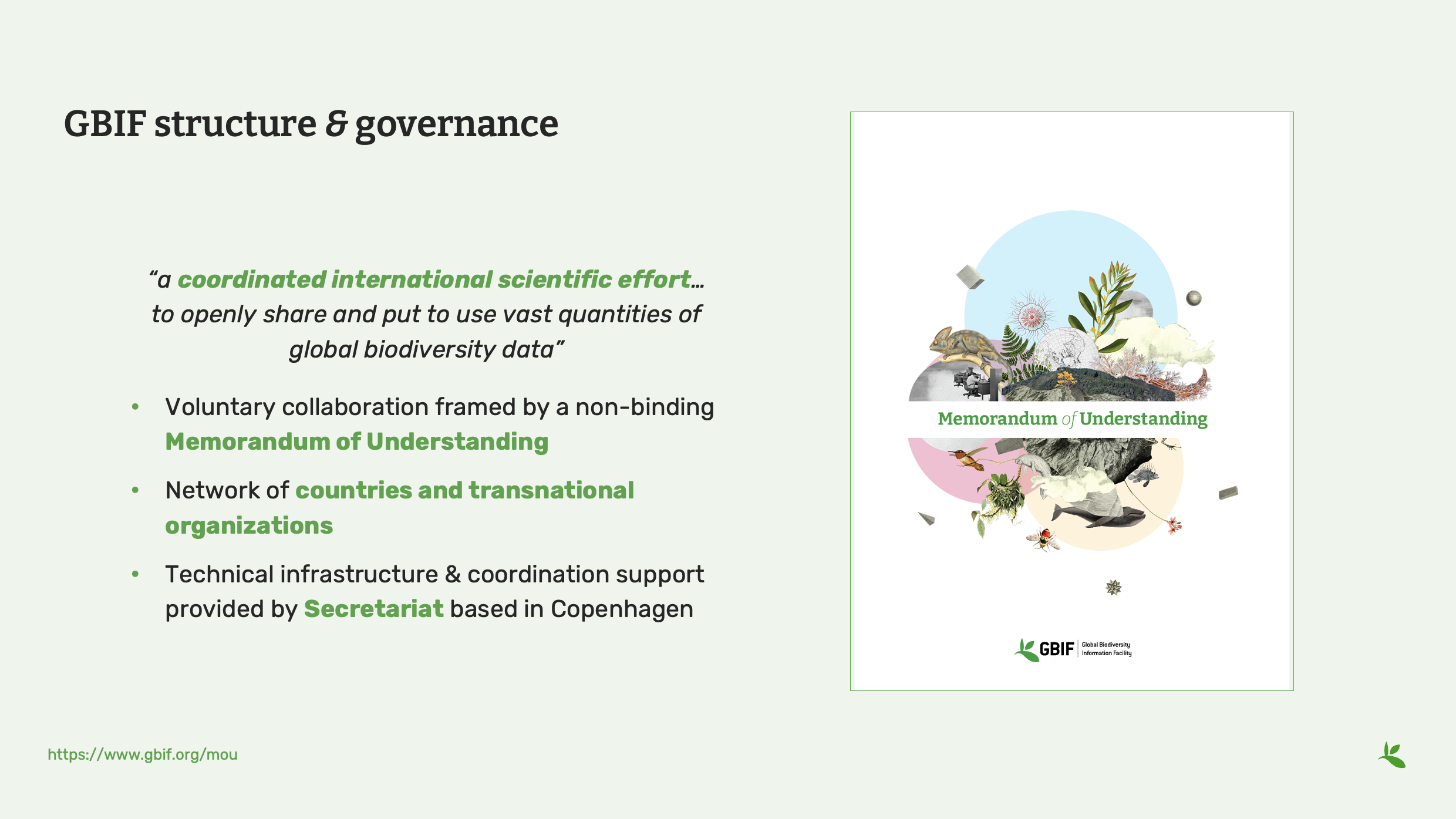
投影片 3 — GBIF 的治理與架構
GBIF 成立於 2001 年,其運作建立在各國政府與跨國組織之間自願簽署的合作備忘錄(MoU)之上,這些合作方構成 GBIF 的正式參與成員。該備忘錄規範了基本治理架構與原則,旨在推動一項國際協作的科學計畫,整合資料、技術與專業能力,使生物多樣性資訊得以自由開放,並支援科學研究與決策應用。依據 MoU,各參與方設立代表團參與 GBIF 治理,並建立國家節點,作為協調資料共享與應用的主要據點。GBIF 秘書處設於丹麥哥本哈根,負責管理技術基礎設施,並促進全球合作,使 GBIF 作為國際社群持續運作與成長。
投影片 4 — 各國為何加入 GBIF?
世界各國政府加入 GBIF,以運用並受益於該網絡所發展與支持的社群型工具、標準與實務方法。這為各參與成員提供了一種高效且有效的方式,用以提升能力並滿足生物多樣性資料需求。GBIF 協助其參與成員提升在研究、資料蒐集與數位化方面的投資效益,建立並協調與國家目標一致的合作夥伴關係,並引導相關工作,以提供支援國家政策目標及全球承諾所需的資料。
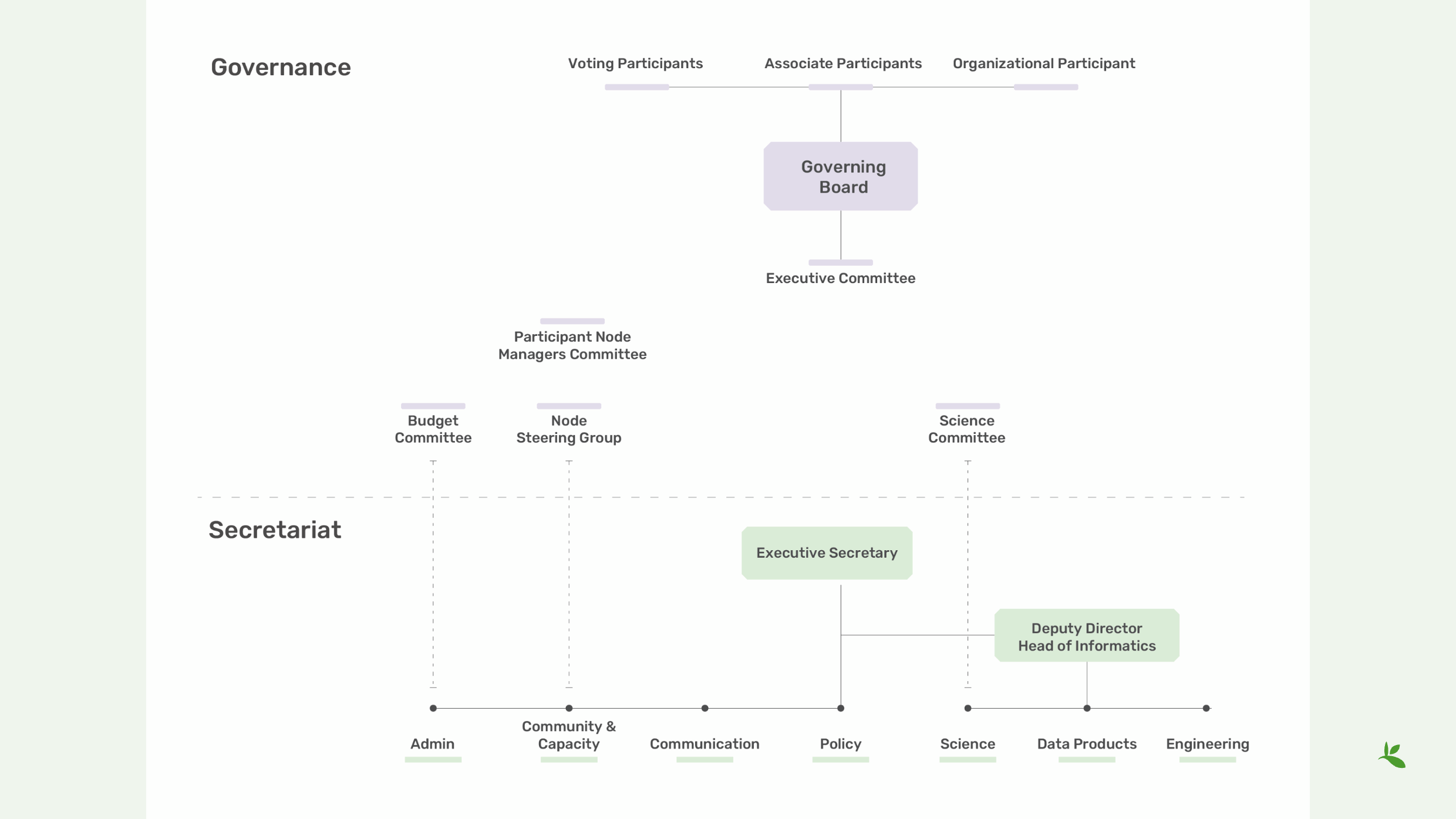
投影片 5 — 治理與架構概覽
GBIF 治理委員會每年召開會議,負責核准年度工作計畫,並決定網絡發展方向。委員會成員由各參與成員的代表團團長組成,代表其所屬國家或組織。在參與成員中,僅有「具投票權的參與國」因對 GBIF 年度預算提供財務支持而擁有投票權;「準參與國」尚未提供財務支持,可維持此臨時身份最長五年;「準組織參與者」則不需提供財務支持。雖然準組織參與者無投票權,但所有參與成員皆可參與治理委員會討論、推薦資料發布者,並參與會議與各項網絡活動。在治理委員會年度會議期間之外,由選任主席領導的各常設委員會,包括預算、科學、節點及執行委員會,持續監督秘書處各團隊所推動的業務,並就相關營運事項作出決策。
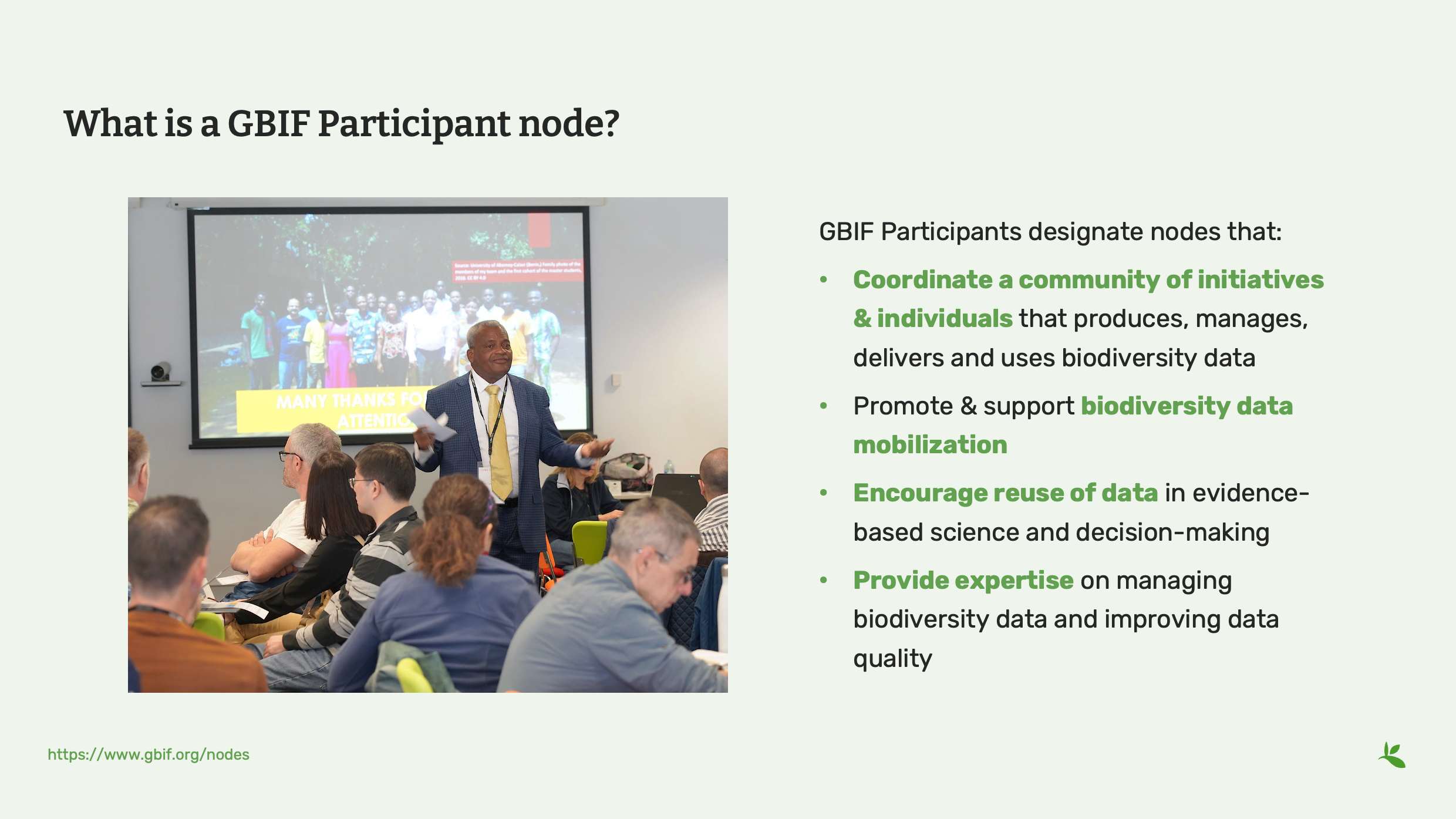
投影片 6 — 什麼是 GBIF 參與節點?
參與成員所設立的節點是其國家或組織中生物多樣性資料共享與應用工作的協調中心,負責串聯相關人員與機構所形成的網絡。 在其所屬機構的支持以及 GBIF 共同資訊系統與工具的協助下,各節點致力於提升生物多樣性資料的可取得性與品質。 運作良好的節點不僅是生物多樣性資料的知識樞紐,也是相關活動的重要交流中心。他們協助使用者尋找合適的資料來源,並分享開放資料與開放科學、資料標準、資料數位化,以及其他生物多樣性工具與倡議相關的專業知識。
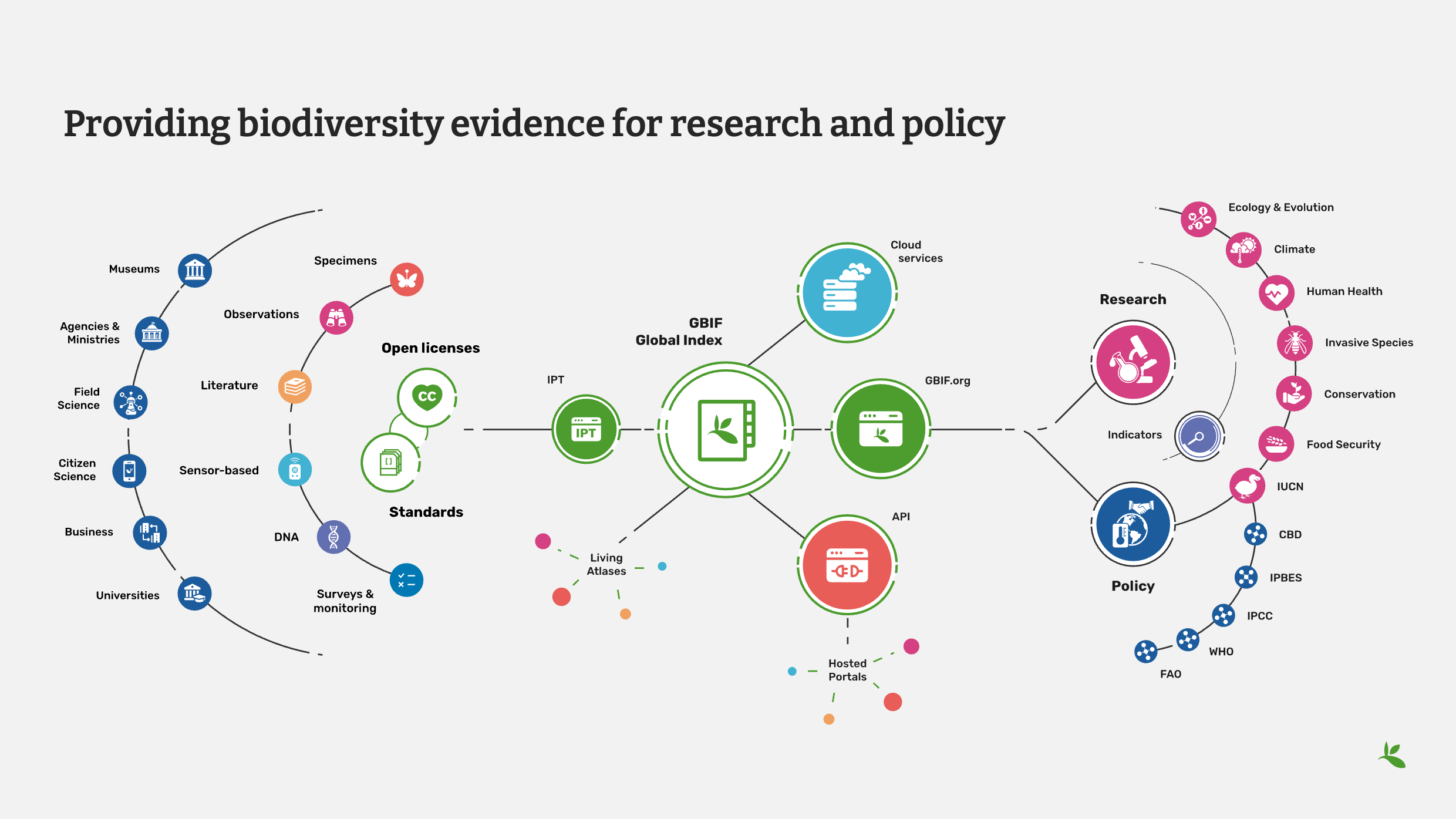
投影片 7 — 為研究與政策提供生物多樣性證據
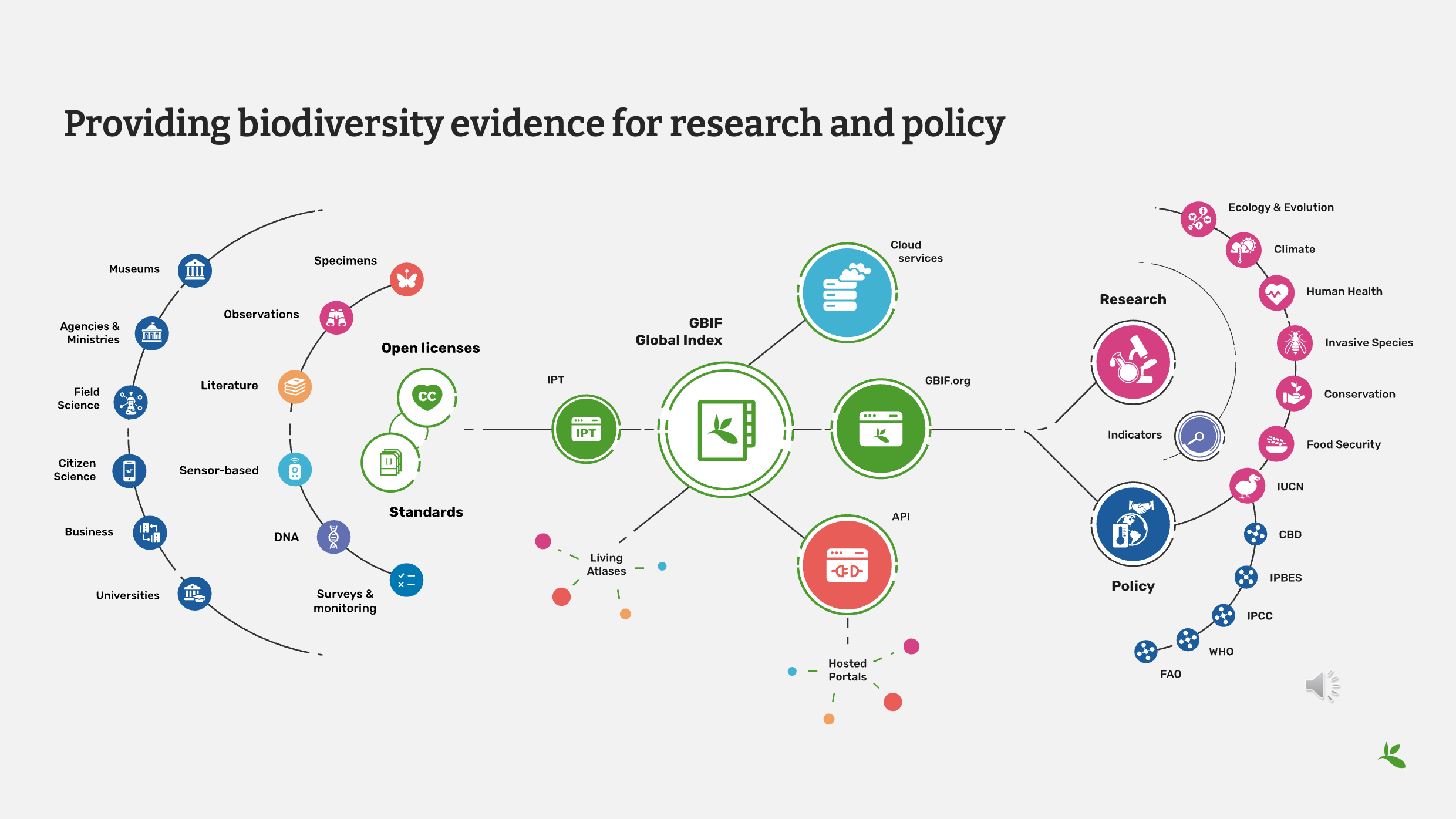
本圖說明 GBIF 如何透過共享工具、共同資料標準及開放授權機制,整合來自不同來源及數千個機構的資料。 這些基礎資料的形式相當多元,包括博物館標本、調查與監測計畫所蒐集的野外觀測紀錄,包含公民科學計畫,以及來自相機陷阱、聲學記錄設備等感測器的資料,甚至是從環境 DNA樣本取得的 DNA 條碼資訊。 將這些不同來源的資料整合後,可以更全面地呈現物種在何時、何地被觀測到的資訊。 使用者則可透過多種方式與格式存取 GBIF 所建立的資料索引,並將其應用於各類與生物多樣性相關的研究、政策制定與決策工作。
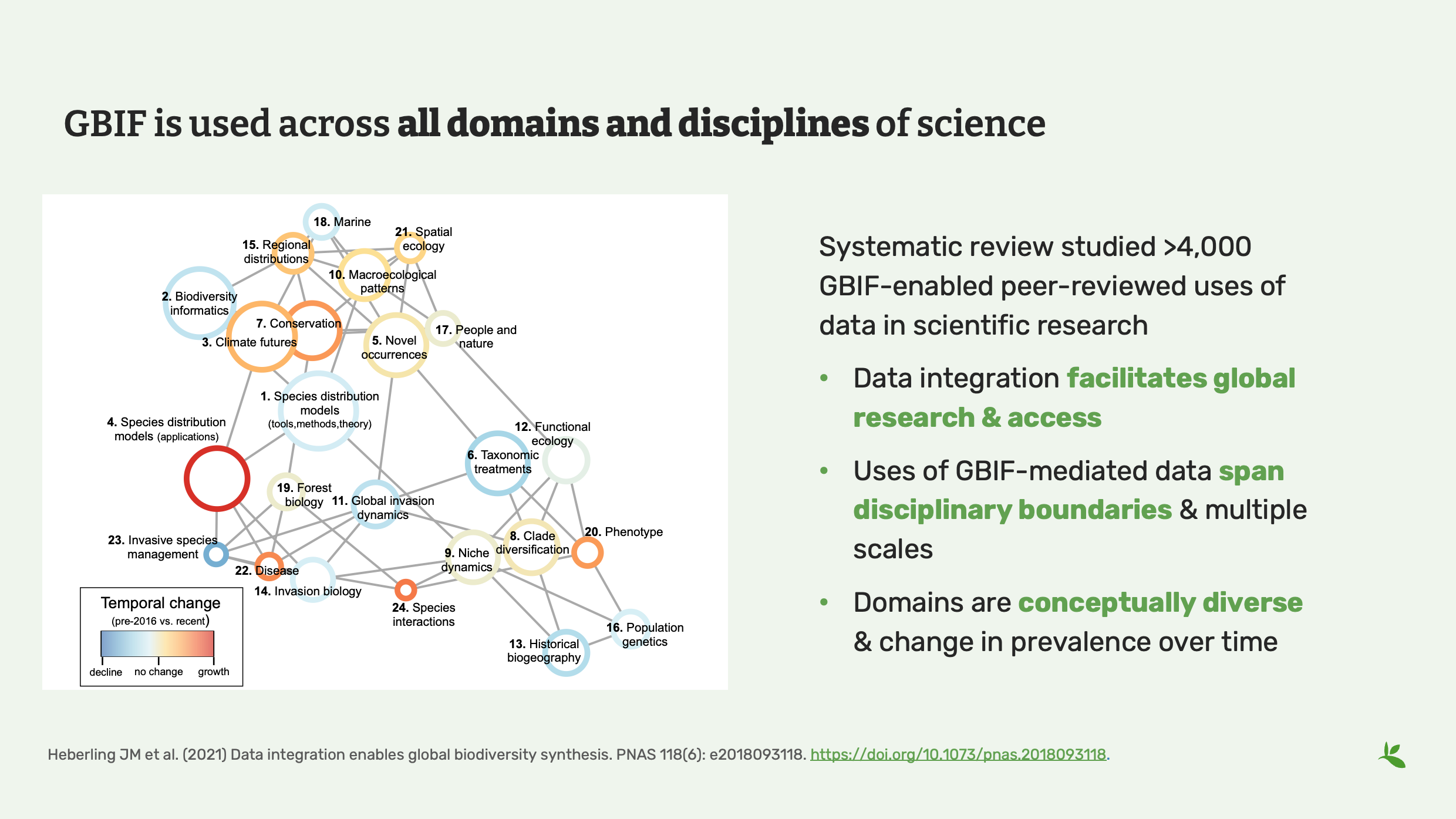
投影片 8 — GBIF 廣泛應用於科學的所有領域與學科
如今,GBIF 已發展成為一個成熟的國際網絡與資料基礎設施,廣泛應用於各個科學領域與學科。 GBIF 所整合的資料不僅促進了全球研究合作與資料共享,也讓研究人員得以從分類群、時間及空間等不同尺度,探討原本難以進行的基礎研究與應用研究問題。
Heberling JM 等(2021)。資料整合促進全球生物多樣性綜合研究(Data integration enables global biodiversity synthesis)。PNAS, 118(6): e2018093118. https://doi.org/10.1073/pnas.2018093118
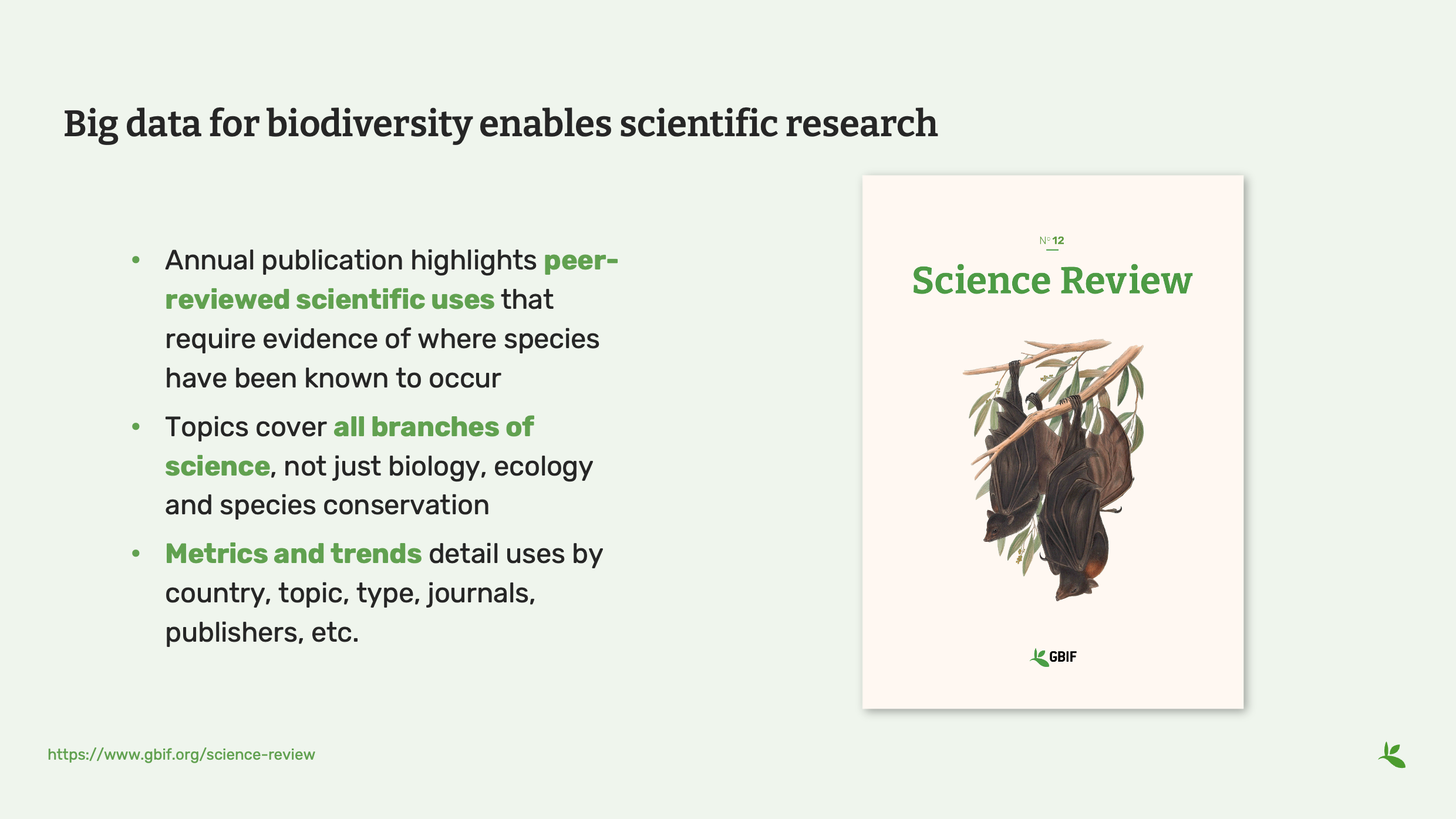
投影片 9 — 生物多樣性大數據促進科學研究
GBIF 秘書處維護一套完善的文獻引用追蹤系統https://www.gbif.org/literature-tracking,用以記錄每週發表、使用 GBIF 所整合資料的數十篇學術論文。 透過這項工作,GBIF 不僅能夠肯定資料發布者的貢獻,也能在每年出版的《Science Review》中,介紹資料的重要應用案例及具代表性的研究成果。 《Science Review》收錄的案例同時也會陸續於網站上發布,協助讀者了解生物多樣性資料如何被應用於基礎研究與應用研究之中。
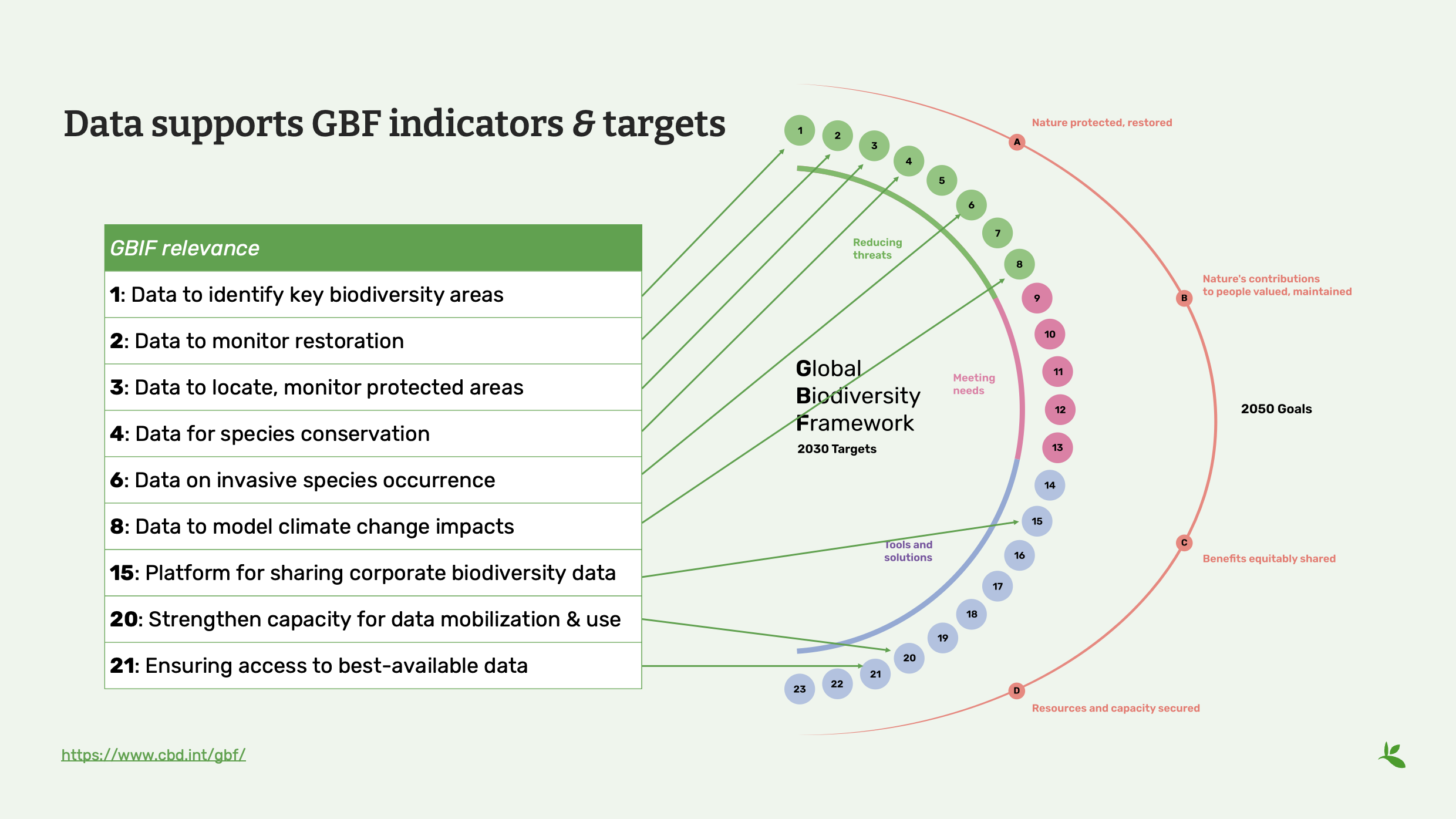
投影片10 — 資料支持 GBF 指標與目標的制定與評估
GBIF 所整合的資料也是生物多樣性相關政策的重要基礎資訊來源。 用於評估物種滅絕風險的數千筆IUCN 物種紅色名錄,都引用了來自 GBIF 的物種出現紀錄資料。 這些資料同時直接或間接作為各類指標與衡量方法的基礎,用以追蹤國際目標的達成進展,例如:昆明-蒙特婁全球生物多樣性框架(Kunming-Montreal Global Biodiversity Framework,https://www.cbd.int/gbf)所訂定的各項目標與承諾。
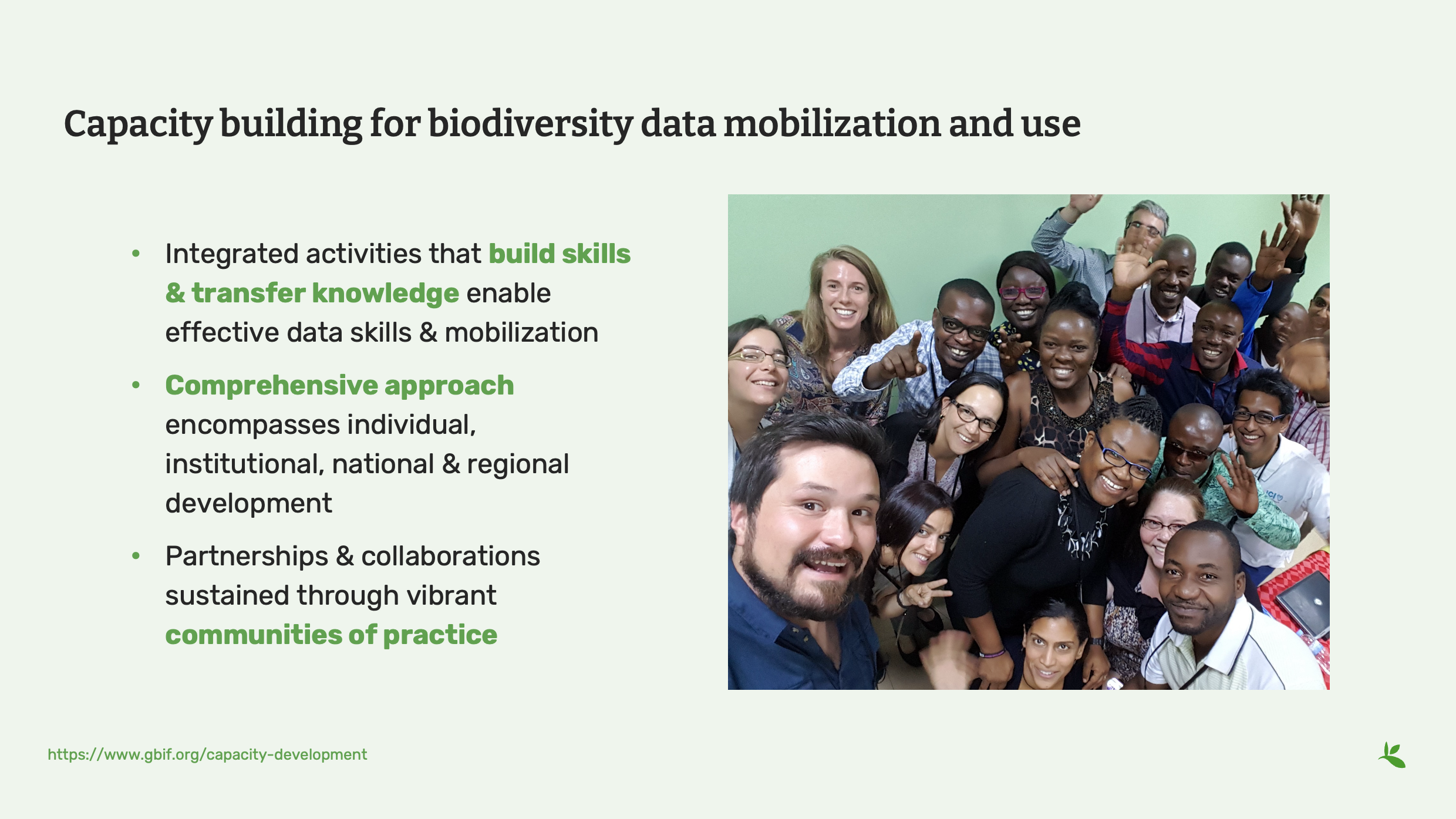
投影片 11 — 生物多樣性資料流通與運用的能力建構
雖然 GBIF 提供多項技術解決方案,但其全球社群一樣很重要,社群中的每一位成員都致力於合作並發展在生物多樣性資料管理、共享與應用方面的技能與最佳實務。 GBIF 的實務社群會共同產出、調整、分享並持續改進各類免費開放的工具、指南文件及其他學習資源,並透過志願者以多種語言進行翻譯,進一步擴大其影響力。 來自 GBIF 各節點及資料發布者的資深實務者,也在你目前所參與的課程等活動中擔任導師與講師,而這類課程正是 GBIF 工作的核心之一。 今日的學員,將成為未來的導師,透過各種規模的計畫、夥伴關係與合作,持續擴展這個全球網絡。
第 12 張投影片 - 結論
謝謝大家,祝一切順利,也歡迎加入 GBIF 社群!
本影片為 GBIF 入門課程系列簡報之一。由我 Kyle Copas 製作並旁白。若你對課程內容有任何疑問,歡迎透過training@gbif.org 與我們聯繫。
GBIF 與科學研究
|
在這段影片(07:52)中,GBIF 首席科學官 Dmitry Schigel 介紹 GBIF 如何透過彙整生物多樣性資料,為科學研究及全球生物多樣性認知提供重要的證據基礎。 如果你無法觀看內嵌的 Vimeo 影片,也可以將影片下載至本機觀看$gbif_for_science_v1(MP4,39.4 MB)。 |
Presentation transcript
Click to expand
投影片 1 — GBIF 與科學研究
本簡報介紹 GBIF 如何透過整合生物多樣性資料,為科學研究及全球生物多樣性認知提供重要的證據基礎。
投影片 2 — 為研究與政策提供生物多樣性證據
接下來,我們將從科學研究的觀點認識 GBIF,並依照圖示由左至右逐一介紹。
在圖的左側,博物館與大學等學術機構,以及政府機關、非政府組織、企業和業餘愛好者社群,都可以向 GBIF 註冊成為資料持有者,並分享其所蒐集、管理或保存的生物多樣性資料。
生物多樣性的原始證據可以是具體的實體資料,例如樣本與標本;也可以是由人類或自動化感測器所記錄的數位資訊。
部分樣本會經過化學分析處理,以揭露其中所包含的生物多樣性訊息。例如,研究人員可從土壤、水體、空氣或木材等樣本中萃取 DNA。相同的方法也廣泛應用於個體標本或混合標本的分析。這些資料共同構成了環境 DNA、DNA 條碼以及高通量分子條碼等重要的生物多樣性證據來源。
這些來自不同來源的資料及其蒐集方法,最終都匯集至 GBIF 的整合索引。透過這個索引,使用者得以在所有共享至 GBIF 的資料集中進行搜尋、篩選及自動化查詢。
在圖的右側,可以看到 GBIF 存在的核心價值。GBIF 能夠提升資料搜尋與資料取得的效率,為使用者節省大量時間;但 GBIF 並不會替你消除資料本身的差異性與限制。 如同使用網際網路搜尋引擎一樣,最終哪些資料適合使用,仍取決於你的需求。圖中以洋紅色表示的科學研究需求,以及藍色表示的政策需求,都將決定哪些資料紀錄適合你的應用情境。
因此,生物多樣性科學實際上發生在兩個層面:左邊是資料發布者,右邊是資料使用者。而生物多樣性資訊學與電腦科學,則透過其技術能力把這兩端連接起來。
投影片 3 — 資料集:資料歸屬、致謝與所屬機構
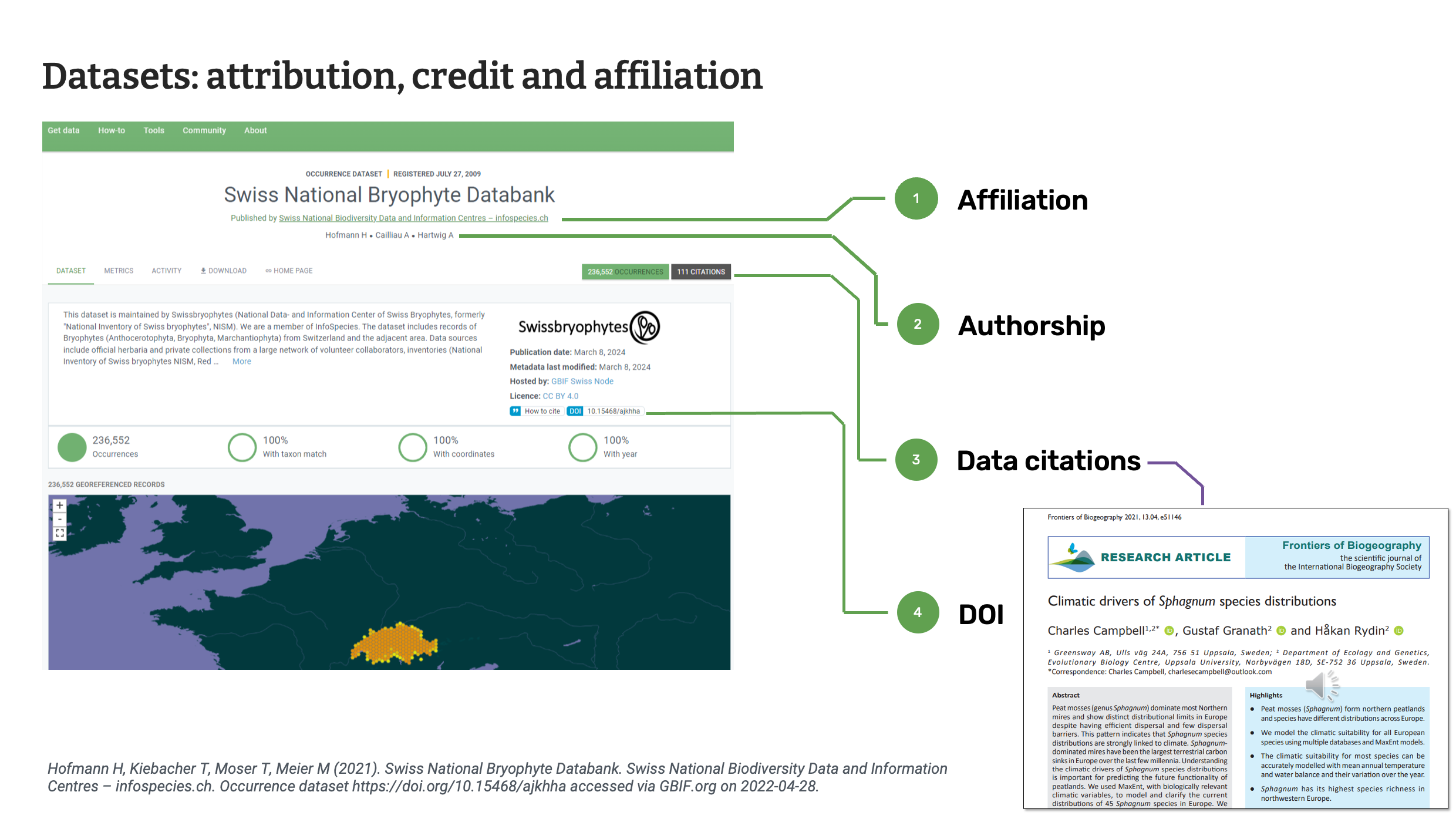
對於研究與學術界的使用者來說,GBIF 的資料集頁面會包含一些熟悉的內容,主要聚焦在引用與隸屬資訊:
首先是資料集的機構隸屬資訊,這同時也是一個連結,會連結到資料發布者的頁面。在 GBIF 中,資料集是由各個組織所共享與發布的。
接下來是資料集的作者資訊,主要包含幾個關鍵角色:資料集的原始創作者、生物多樣性紀錄的主要貢獻者,以及詮釋資料的撰寫者。詮釋資料撰寫者的角色是確保該資料集在 GBIF 上的數位化描述是正確且完整的。
第三點是:在資料集頁面中,只要該資料集的任一筆紀錄曾被引用過一次,就會顯示一個持續累積的數字,以及相關連結,指向使用該資料集所產出的研究論文。
第四個也是最後一個元素,是資料集的 DOI。這是一個唯一的數位物件識別碼,讓我們能夠進行文獻追蹤。 當任何資料被使用時,使用者都應引用該資料集的 DOI。
在這個特定案例中,一筆關於苔蘚植物,亦即來自瑞士的https://doi.org/10.15468/ajkhha[苔蘚資料集],已被一項由瑞典研究團隊進行的研究所使用,該研究分析了泥炭蘚的氣候與分布關係https://doi.org/10.15468/dl.36wam3。 而這只是超過 150 項建立在該資料集之上的研究之一。
投影片4 — 使用 GBIF 整合資料的同儕審查論文
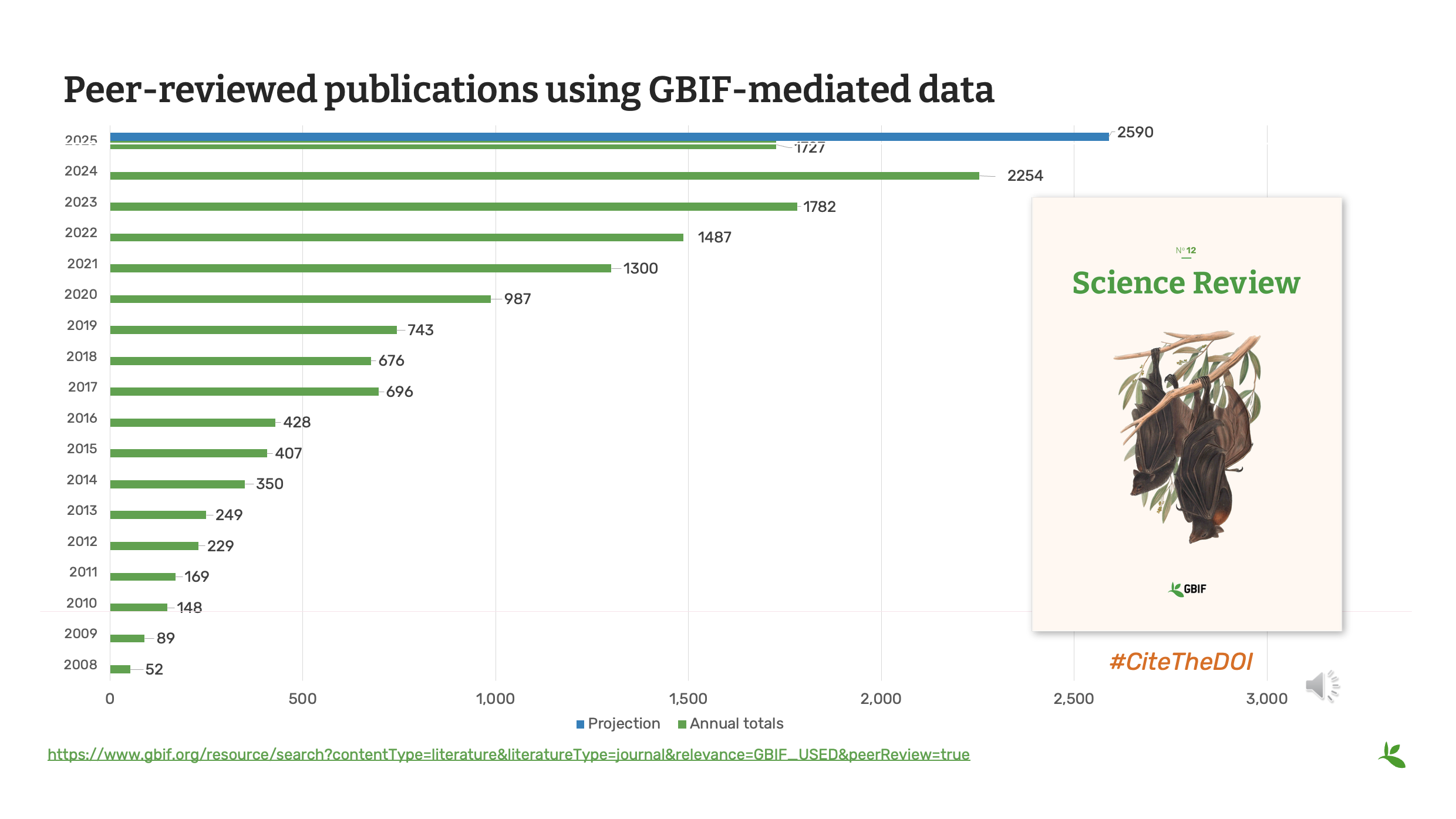
透過秘書處的https://www.gbif.org/literature-tracking文獻追蹤計畫,我們可以了解 GBIF 整合資料在科學文獻中的使用情況,並發現其使用量正持續增加。
The GBIF Science Review每年都會從文獻追蹤計畫所蒐集的研究成果中,精選具代表性的案例加以介紹。 回顧中所摘要的同儕審查論文,雖然僅呈現其中一部分研究成果,卻能幫助我們了解 GBIF 參與者、節點與資料發布者所組成的網絡,如何透過提供自由且開放的生物多樣性資料,支援並促進各類研究工作。
投影片5 — GBIF 推動之科學研究的系統性回顧
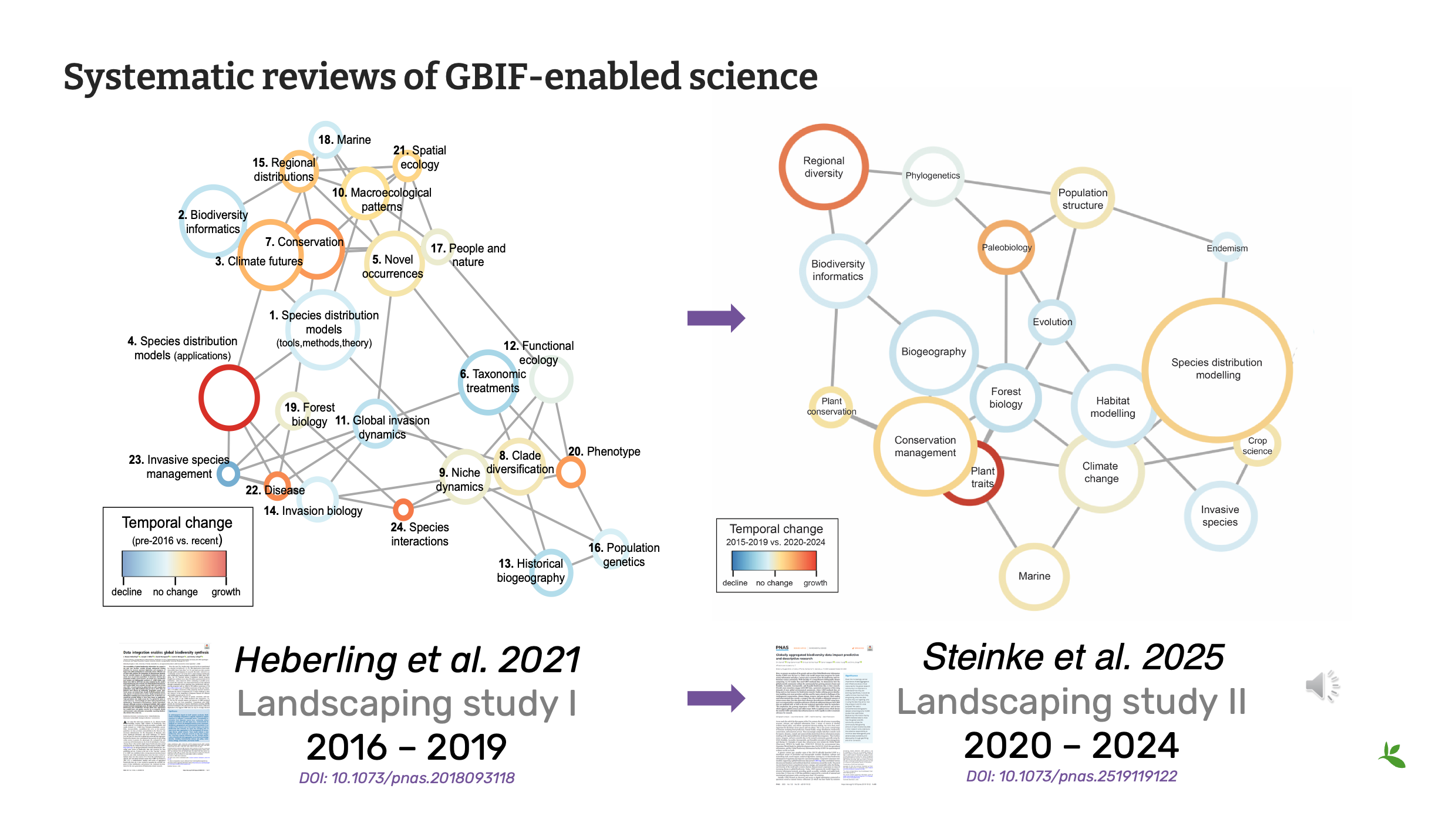
隨著研究人員愈來愈普遍地透過 DOI 引用資料,GBIF 得以更完整地監測與分析 GBIF 支持之科學研究的發展概況。 每隔五年,GBIF 都會對相關研究文獻進行系統性回顧,以了解 GBIF 資料在科學研究中的使用模式與趨勢。
在左圖中,你可以看到 2016 至 2019 年間 GBIF 相關研究主題的分布情形,包括各主題的規模、主題之間的關聯性,以及不同主題隨時間變得更加熱門或變冷門的趨勢。 右圖則呈現 2020 至 2024 年期間的研究主題分布概況。
這些研究為 GBIF 網絡帶來兩項重要的實證資訊:一方面,有助於了解 GBIF 資料在科學分析中的應用演變;另一方面,則有助於掌握 GBIF 在推動科學研究上的角色定位與發展趨勢。
https://doi.org/10.1073/pnas.2018093118 Heberling 等人,2021 年,《資料整合促進全球生物多樣性綜合分析2016–2019》,DOI: 10.1073/pnas.2018093118
https://doi.org/10.1073/pnas.2519119122 Steinke 等人,2025 年《全球彙總生物多樣性資料對 2020–2024 年預測性與描述性研究之影響》
投影片 6 — GBIF 推動的科學:各時期的研究主題:2010 – 2024
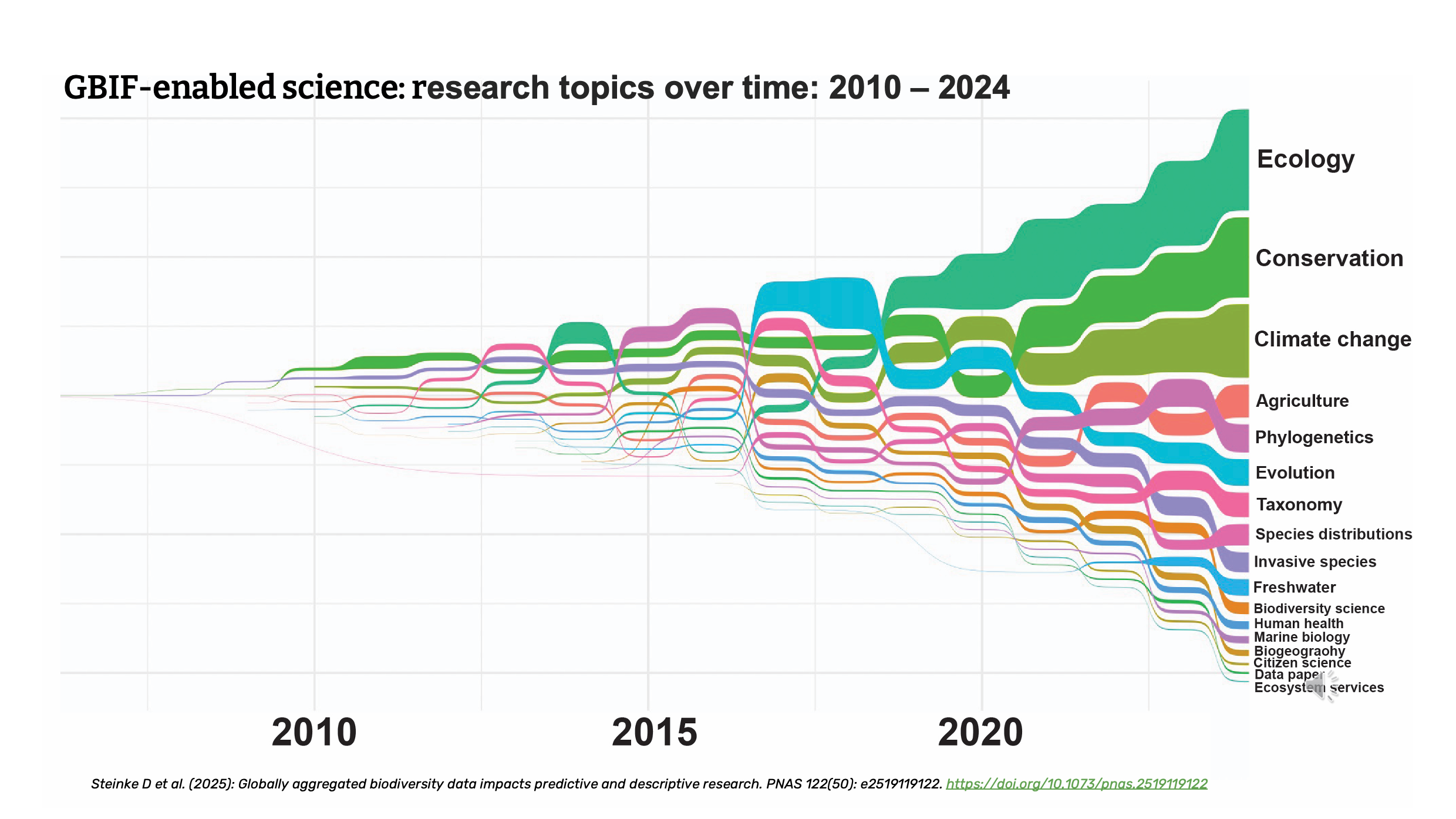
這些系統性回顧顯示了哪些趨勢與模式呢? 使用 GBIF 資料所進行的研究主要聚焦於生態學,並經常結合保育、、氣候變遷、農業、系統發育學、演化學、分類學以及物種分布等主題。 這些研究主題的重要性也隨時間而變化,其中以「生態學與氣候變遷」相關研究的成長最為明顯(自 2019 年起持續增加),而「農業」相關研究則在 2023 年出現顯著增長。
Steinke D 等人(2025):全球彙總的生物多樣性資料對預測性與描述性研究的影響。PNAS 122(50):e2519119122。 https://doi.org/10.1073/pnas.2519119122
投影片 7 — GBIF 的主題相關性
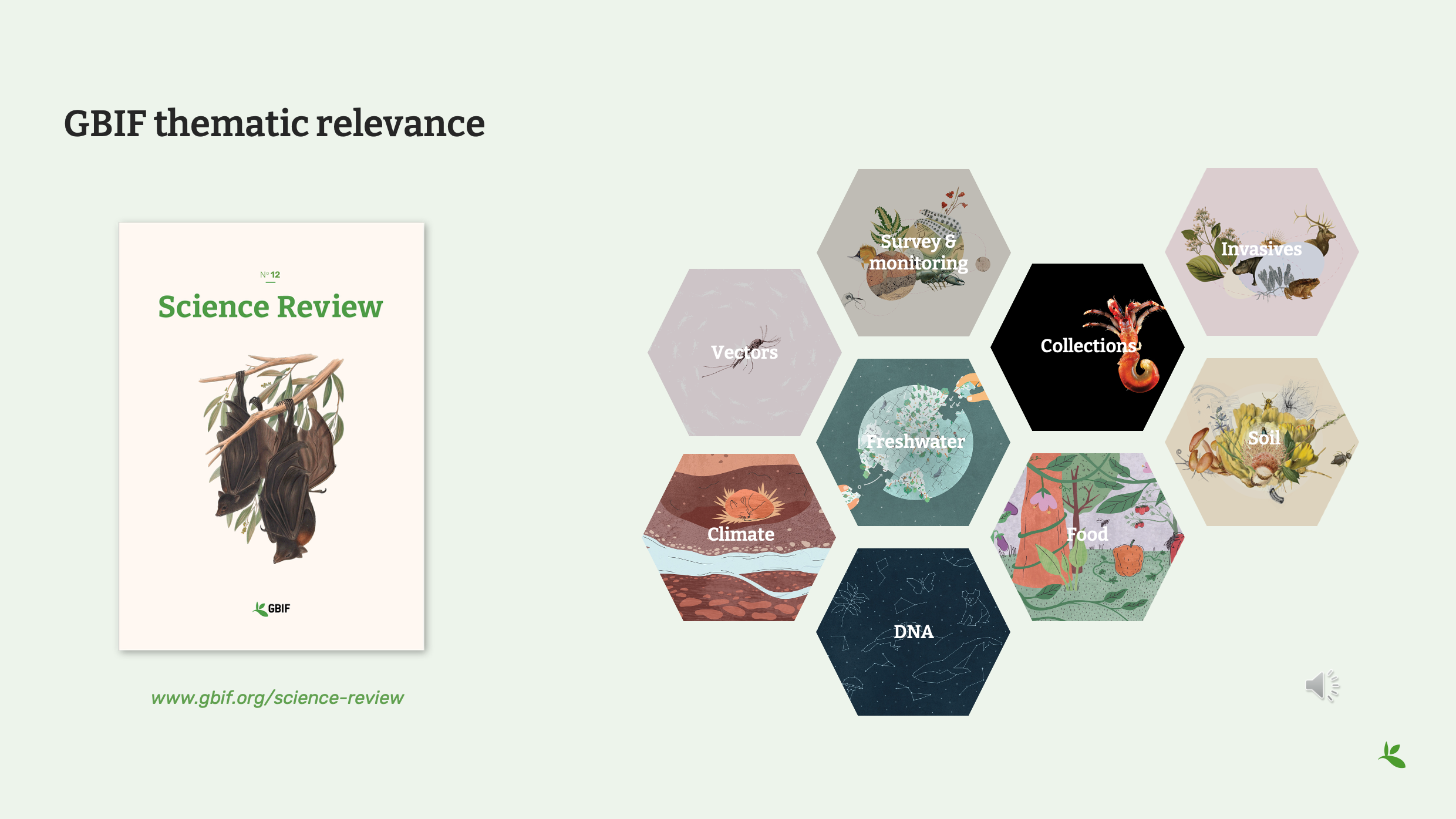
透過 GBIF 共享的資料https://www.gbif.org/composition/2SEGqoMS8eMVos9T1owEEk[可應用於眾多學科與研究傳統^]。舉例來說:
保育,包括保育生物學以及以科學證據為基礎的管理措施,例如保護區的規劃與設計,以及透過追蹤外來入侵種目前及預測的擴散情形,評估其對物種造成的威脅。
在農業生物多樣性方面,GBIF 資料有助於研究作物野生近緣種的分布情況。
另一個與人類相關的領域是人類健康。在 GBIF 中,可以找到許多作為疾病媒介、宿主與病原儲存庫的物種資訊。
GBIF 提供歷史與近期的生物多樣性資料,因此能推動研究環境變遷對物種與群落的影響。這類研究多半使用模型方法,而 GBIF 資料則作為基準與輸入資料。
投影片 8 — 使命與願景
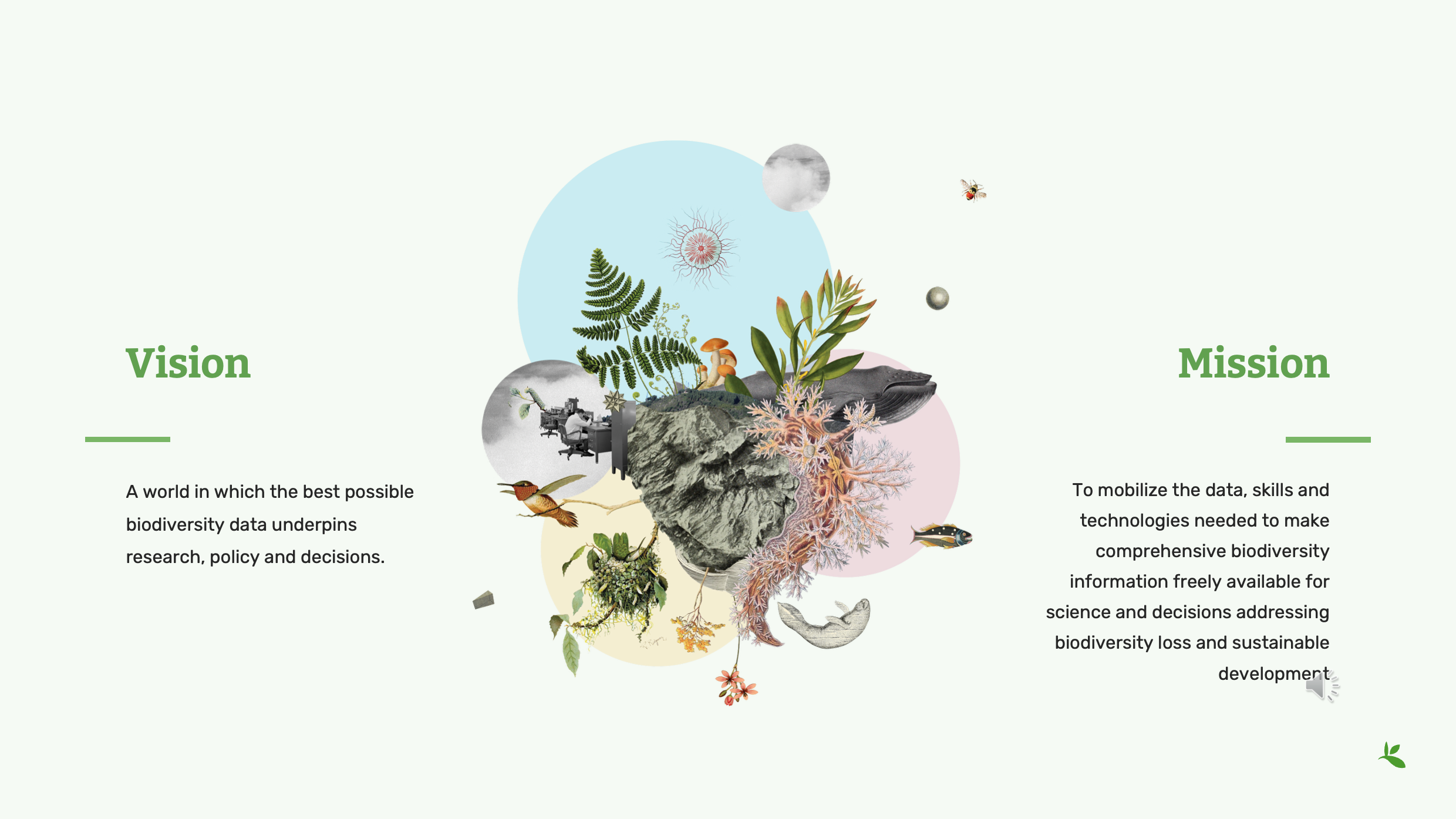
GBIF 的目標是建立證據基礎,推動科學研究,並促進全球對生物多樣性的理解。GBIF 在科學與研究領域的影響力最為明顯,也因基於 DOI 的文獻追蹤機制而有完善的紀錄。同時,GBIF 也透過國際合作協調科學工作,致力於讓國家與個人都能公開獲取生物多樣性資料。
投影片 9 - 結論
This video is part of a series of presentations developed for the Introduction to GBIF course. It was created and narrated by me, Dmitry Schigel. If you have any questions on the course content, you can reach out at training@gbif.org.
GBIF Participant Nodes
|
In this video (08:05), Mélianie Raymond, GBIF Head of Community and Capacity, explores the important role that nodes play in GBIF. If you are unable to watch the embedded Vimeo video, you can download it locally (MP4 - 48.5 MB). |
Presentation transcript
Click to expand
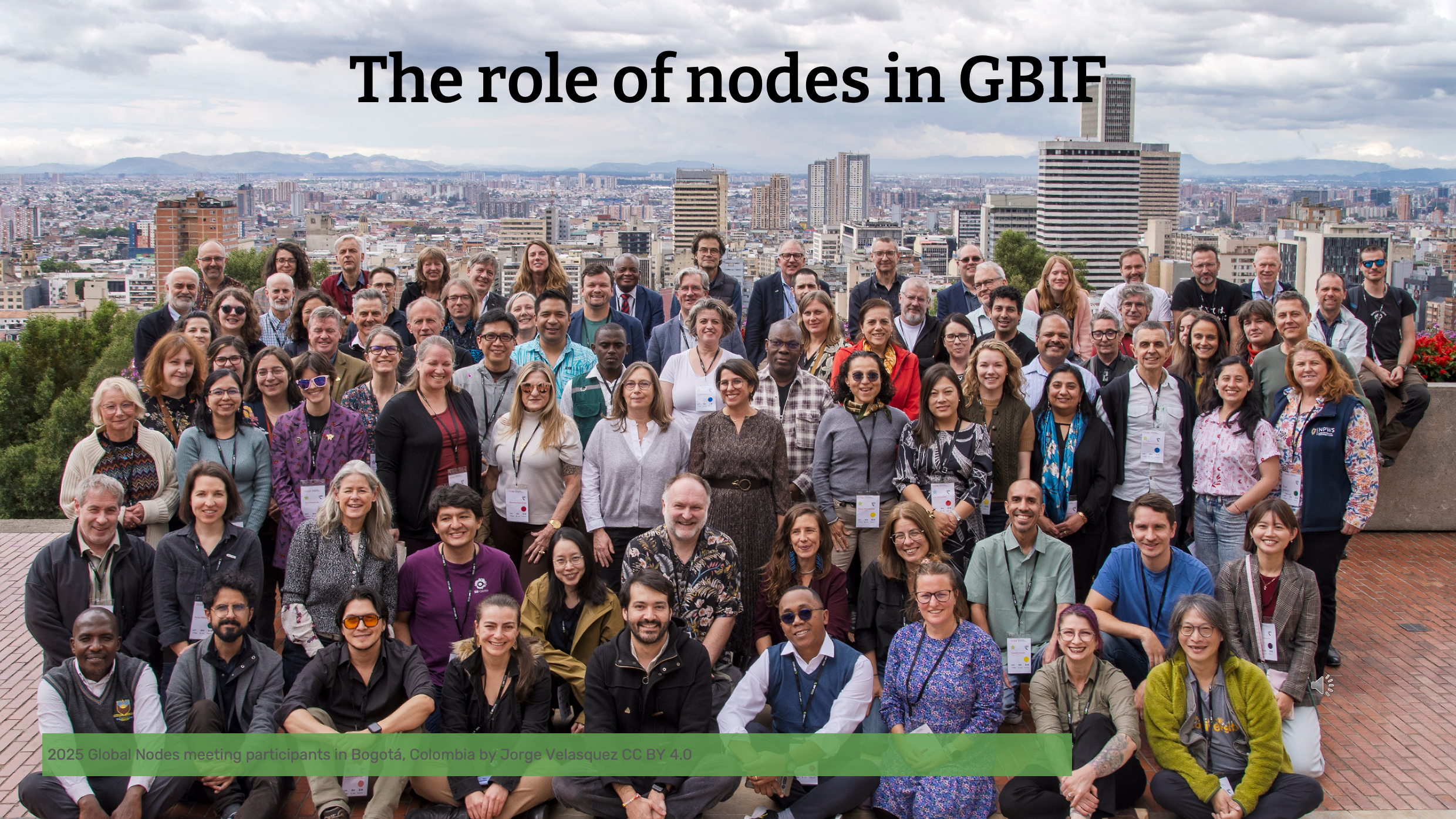
Slide 1 - The role of nodes in GBIF
In this video, we’ll explore the important role that nodes play in GBIF—the Global Biodiversity Information Facility.
GBIF is both a data infrastructure and an international network that exists to enable free and open access to biodiversity data from all sources.
Here, we’ll focus on one key part of this network: the role of GBIF Participant nodes.
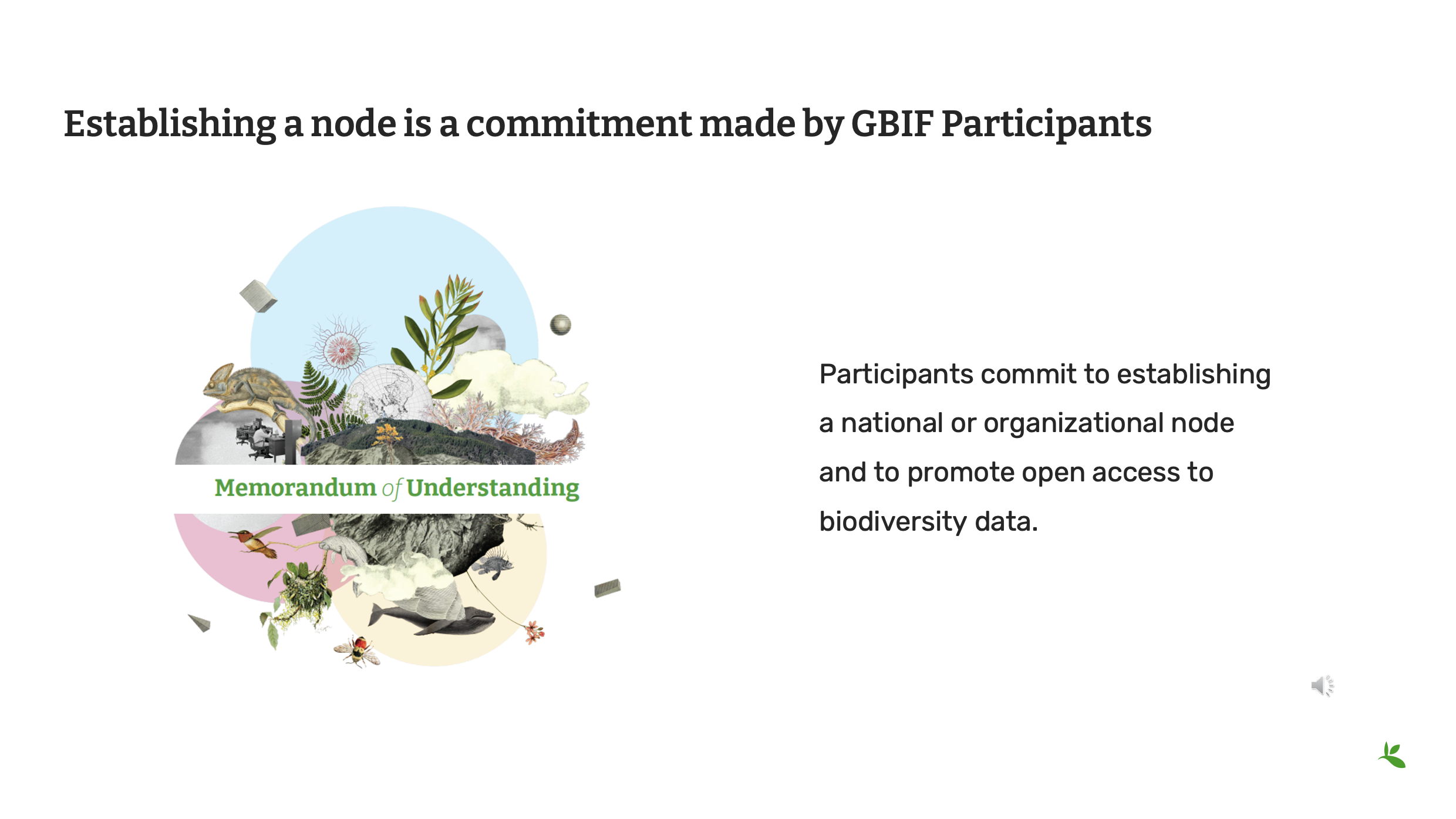
Slide 2 - Establishing a node is a commitment made by GBIF Participants
GBIF is an intergovernmental initiative and its members—formally known as Participants consist of countries, economies, and international organizations working together to promote open access to biodiversity data.
To join, Participants sign a Memorandum of Understanding, confirming their commitment to share biodiversity data openly.
In signing the MOU, each Participant also commits to establishing a national or organizational node.
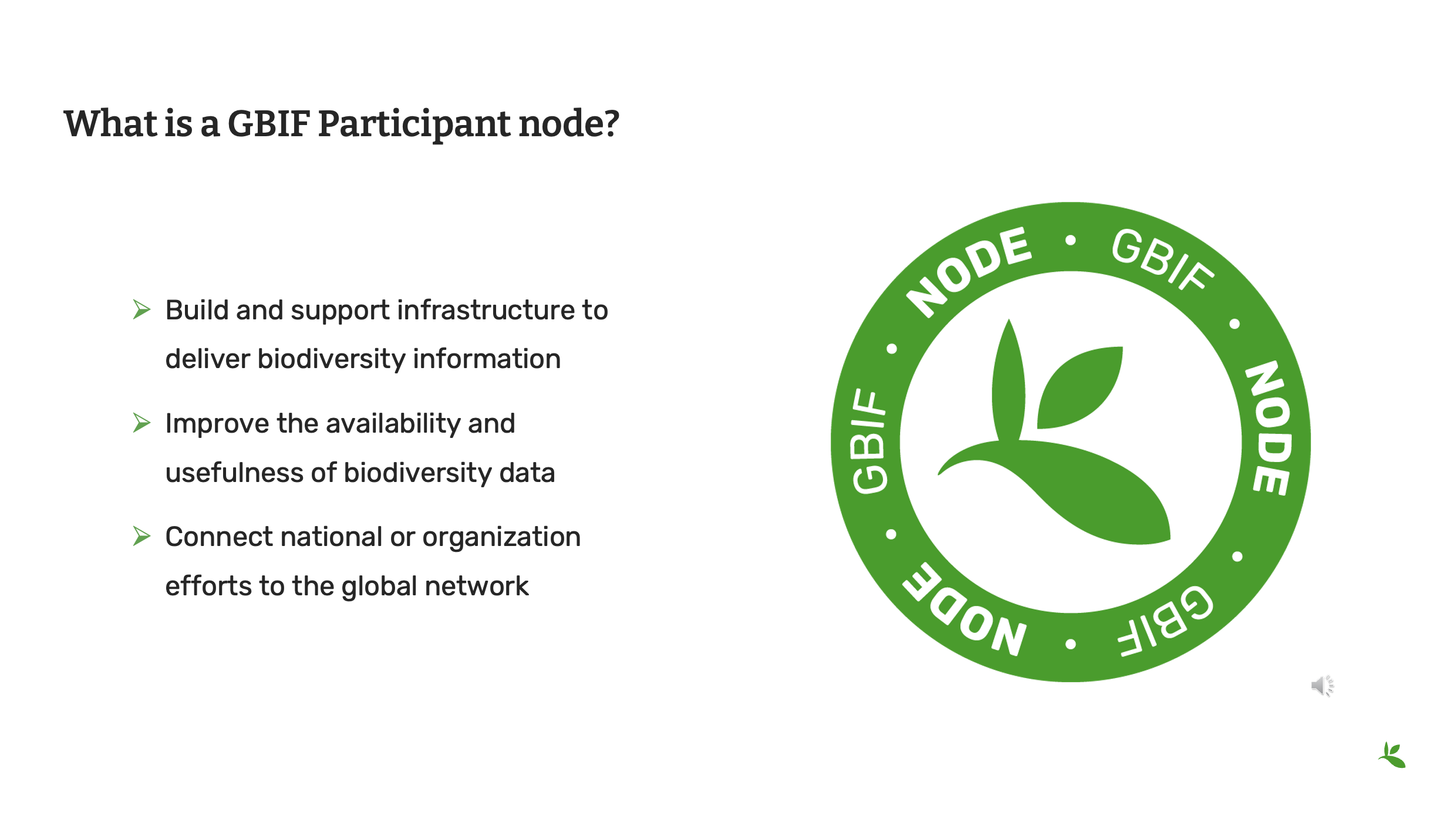
Slide 3 - What is a GBIF Participant node?
A node is a team designated by a country or organization participating in GBIF. Its role is to coordinate a network of people and institutions that produce, manage, and use biodiversity data.
Together, they build and support the infrastructure needed to deliver biodiversity information.
Nodes work to improve both the availability and the usefulness of biodiversity data—for research, policy, and decision-making.
And by participating in GBIF, they connect their national or organizational efforts to a global network.
Slide 4 - National and organizational nodes
GBIF nodes fall into two main categories: national and organizational.
National nodes are established by countries. They coordinate biodiversity data sharing at the national level, often under a formal mandate and governance structure, such as a board or steering committee.
This allows data holders, researchers, policymakers, and other partners to work together and set priorities for how the country participates in the GBIF network.
Organizational nodes, on the other hand, are established by the international organizations that participate in GBIF.
They often focus on specific themes or regions, and help extend the reach of the GBIF network.
These two types of nodes complement each other, strengthening collaboration across countries, regions, and thematic areas.
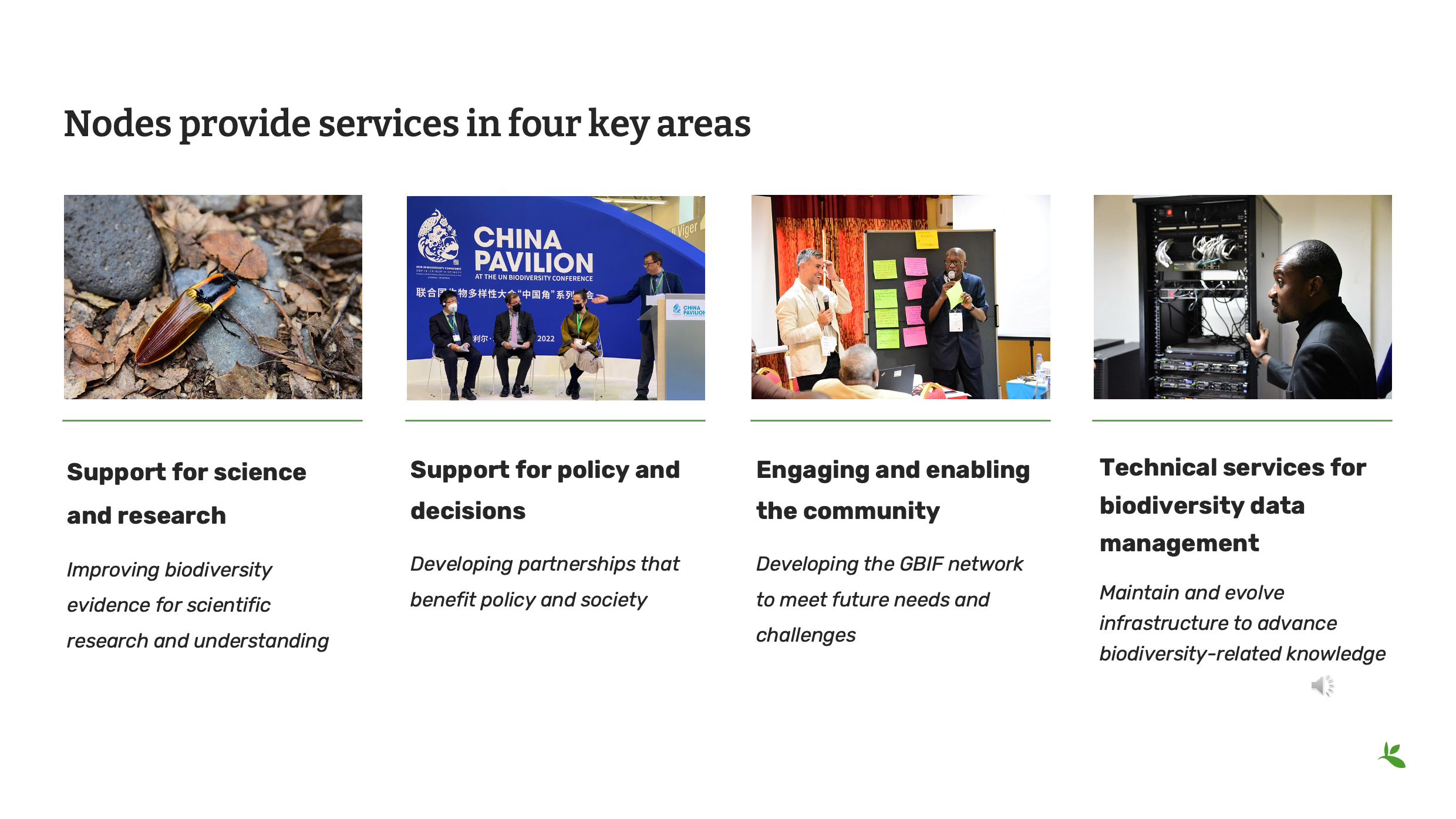
Slide 5 - Nodes provide services in four key areas
Broadly, the services and responsibilities of all nodes can be grouped into four main categories:
-
Support for science and research
-
Support for policy and decisions
-
Engaging and enabling the community
-
Technical services for biodiversity data management
We will now look at the benefits that nodes provide in each of these areas.
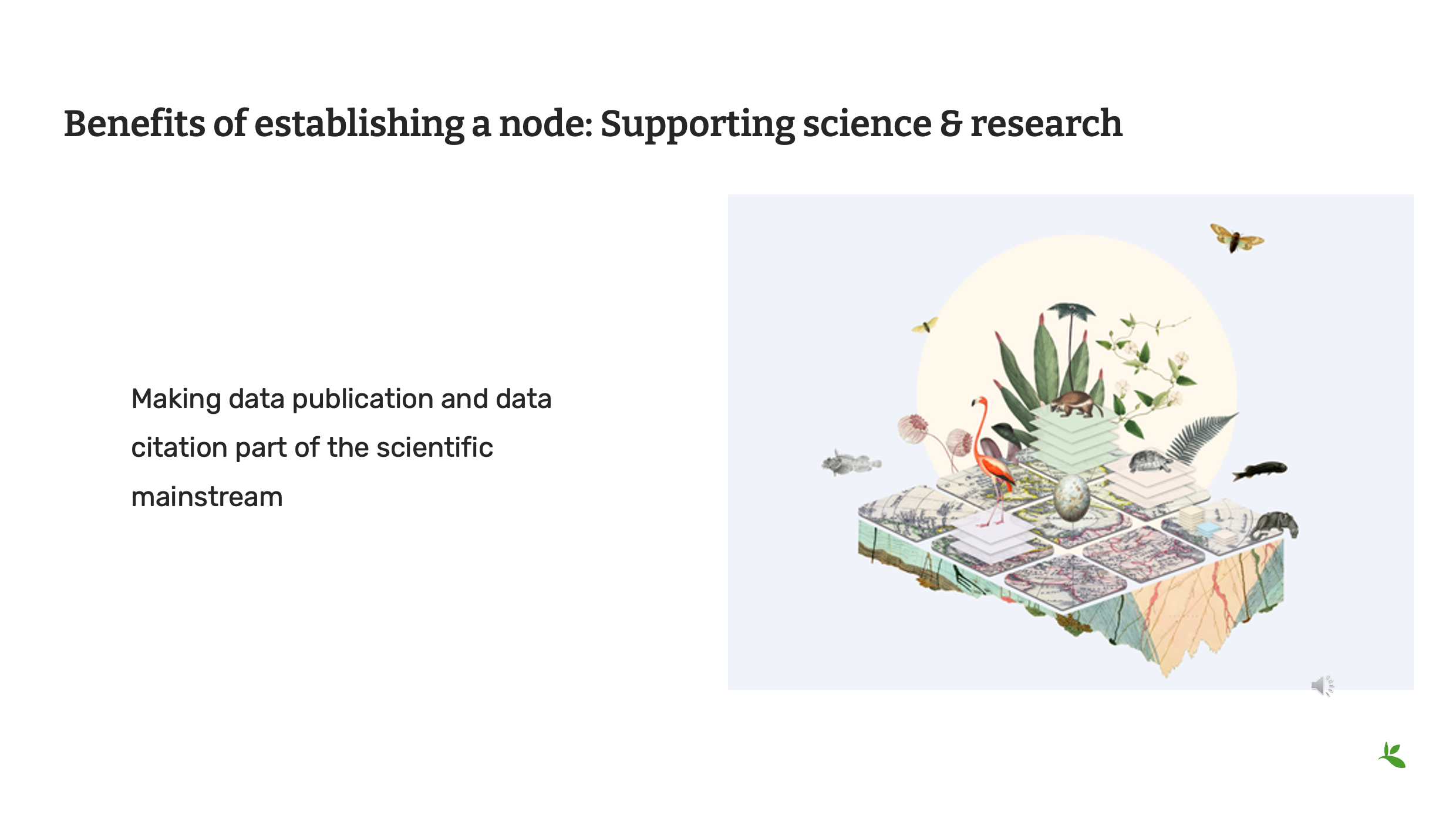
Slide 6 - Benefits of establishing a node: Supporting science & research
Nodes help Participants get more value from their investments in biodiversity research and data collection—past, present, and future.
They support biodiversity data holders in publishing and sharing data using common standards, making it easier to discover, combine, and reuse across studies.
They help make the publication of primary data - and the citation of its reuse - part of the scientific mainstream.
This supports both basic and applied research, and advances our understanding of biodiversity at local, national, and global scales.
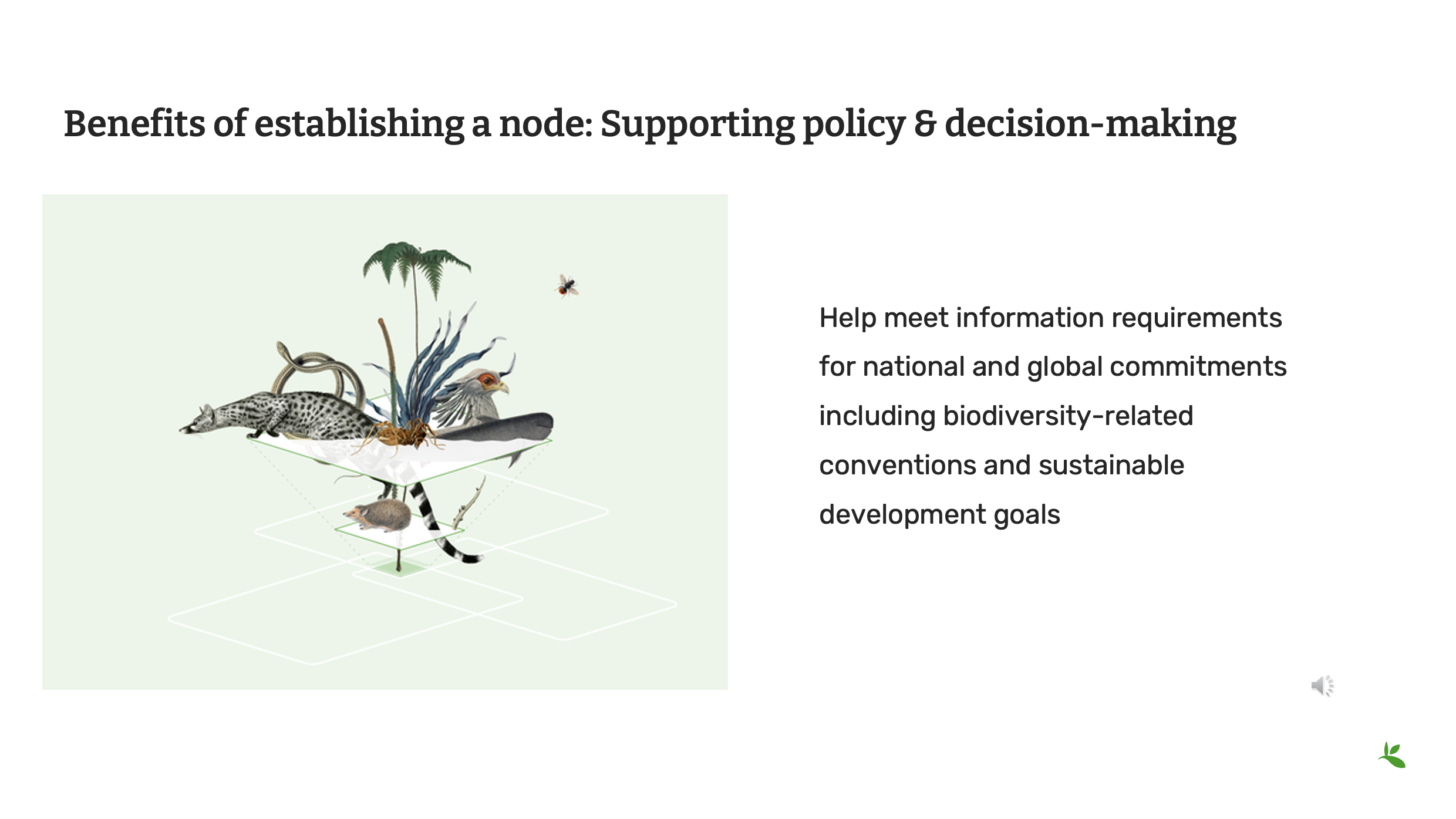
Slide 7 - Benefits of establishing a node: Supporting policy & decision-making
Nodes promote open data practices and help establish the data flows that allow biodiversity data to inform policy and decision-making.
This includes supporting information needs for biodiversity strategies, conventions, and sustainable development goals.
Participant nodes and biodiversity information facilities are therefore instrumental in helping Participants achieve their own biodiversity data-related goals and targets.
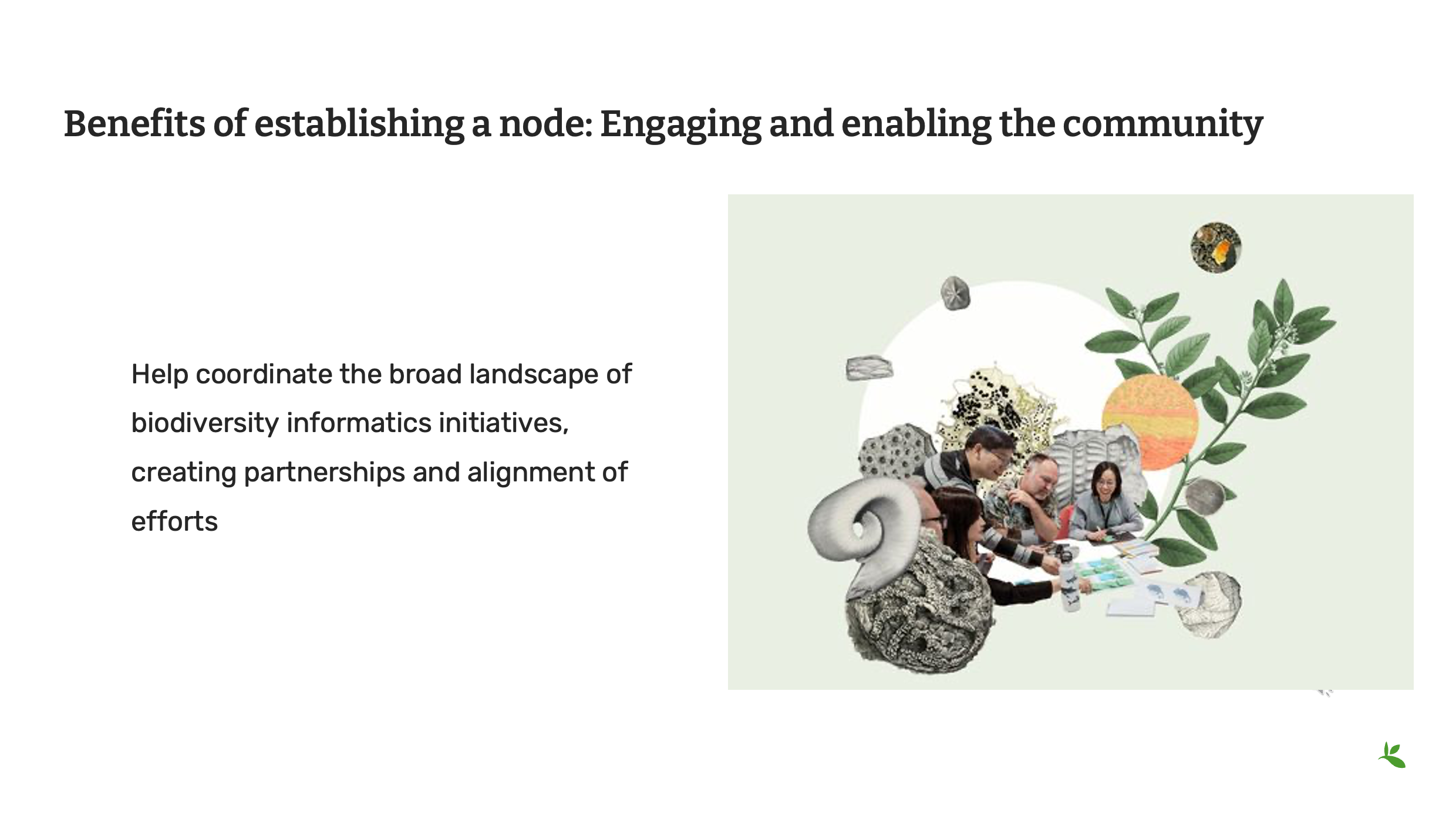
Slide 8 - Benefits of establishing a node: Engaging and enabling the community
Nodes play a key role in building and supporting a strong biodiversity data community.
Through training and outreach, nodes help grow the network and develop skills across the community.
Nodes also connect with other nodes to share knowledge and experience. This increases the efficiency of establishing biodiversity data sharing networks.
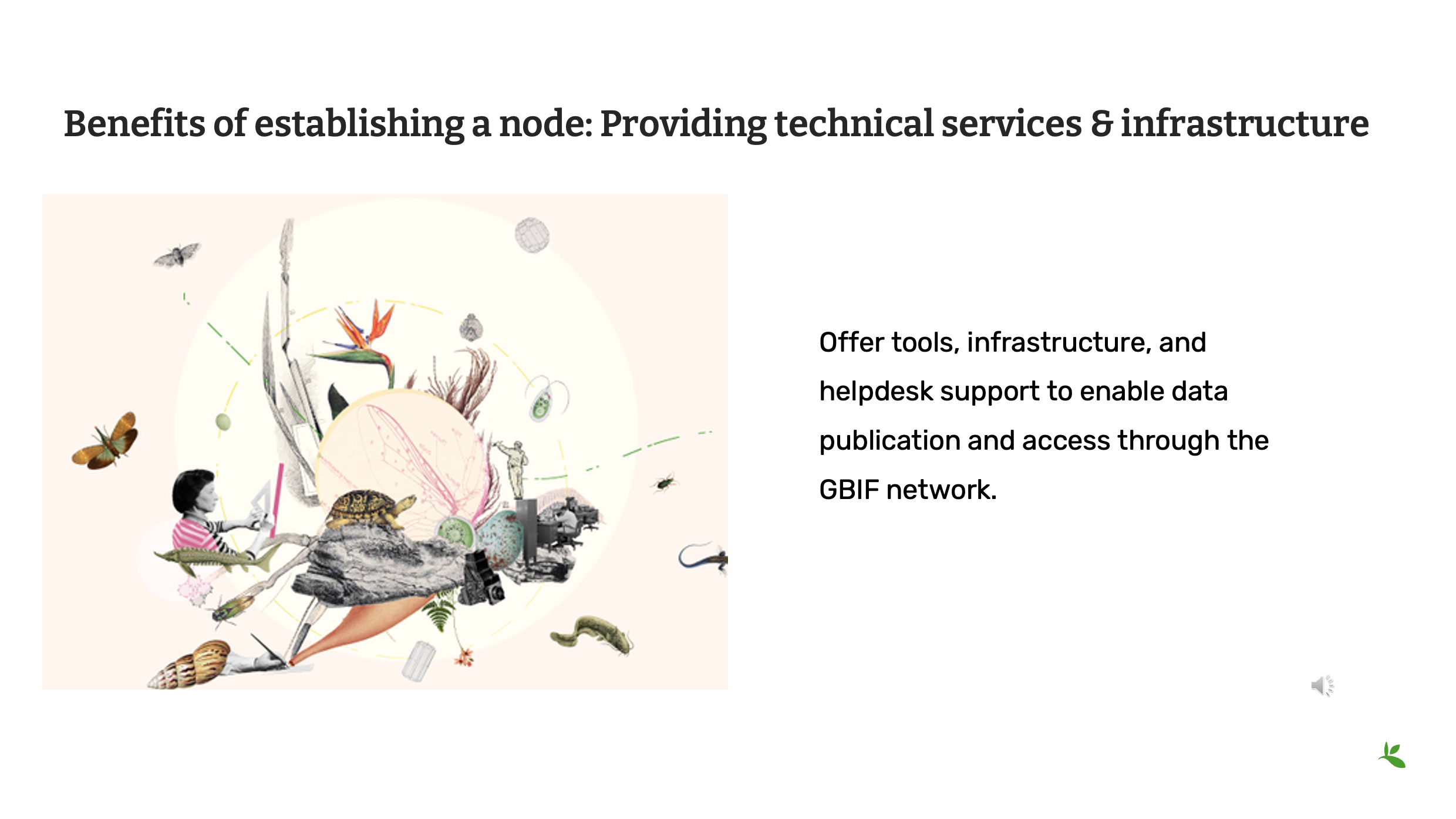
投影片 9 — 建立節點的好處:提供技術服務與基礎設施
最後,各節點提供了管理與共享生物多樣性資料的技術基礎。
他們提供工具、基礎設施與支援服務,協助資料的發布與存取。
透過與 GBIF 建立連結,各節點讓其網絡所蒐集與整理的資料,能與其他國家及組織所發布的相關資料進行整合。
因此,原本為國家或組織需求而整理的資料,也能被更廣泛的國際社群再利用。這也提升了參與者資料發布機構與資料流通工作的能見度。

投影片 10 — 參與者角色
當參與者加入 GBIF 時,會指派兩個主要角色:代表團負責人與節點管理員。
代表團負責人在 GBIF 管理委員會中代表國家、經濟體或組織,同時也是該參與者在所有GBIF相關事務中的主要聯絡人。
The node manager leads the operational activities of the country or organization in coordinating the mobilization and use of open-access biodiversity data, and also represents the Participant on the GBIF Participant Node Managers Committee.
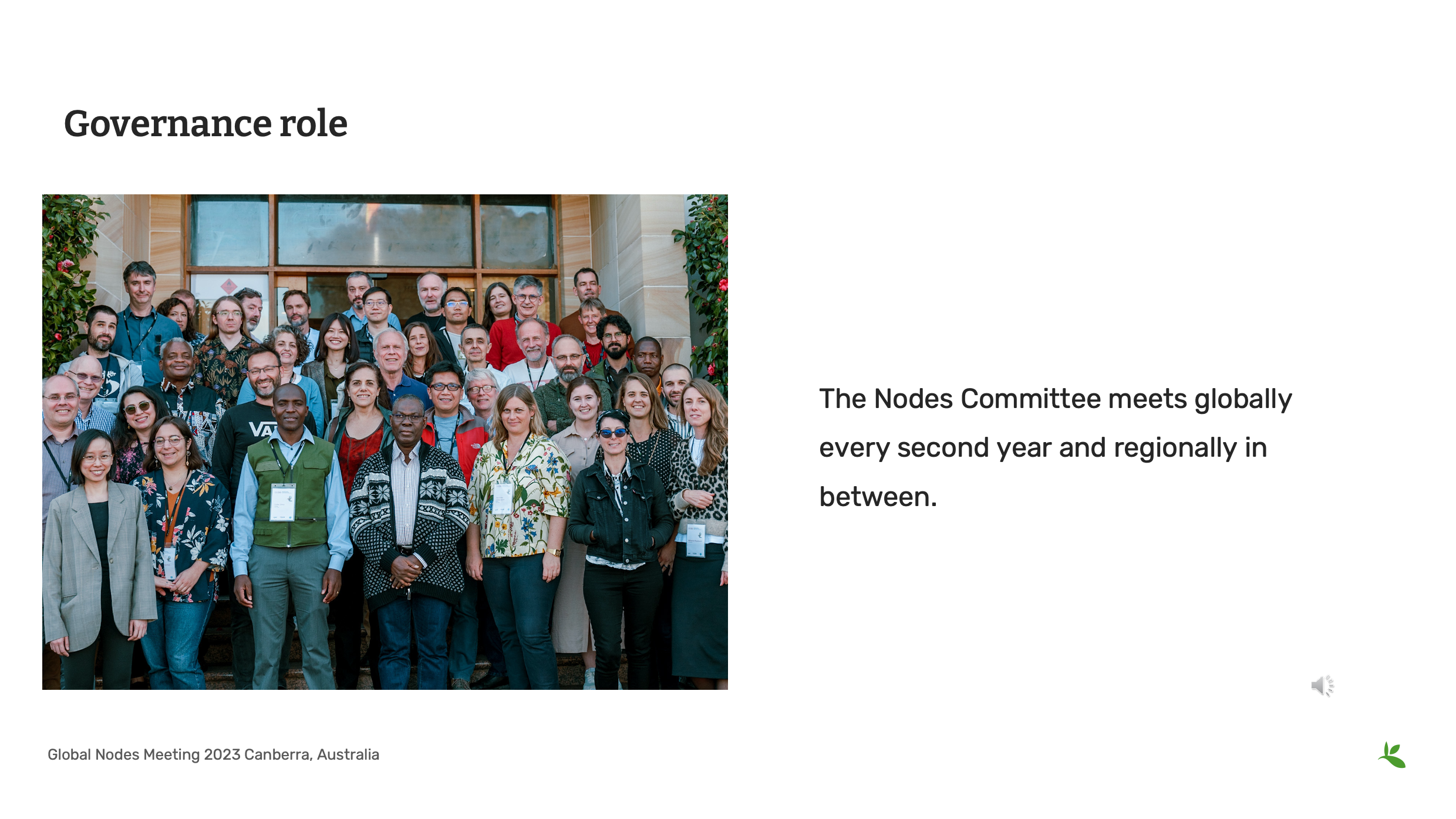
Slide 11 - Governance role
Nodes therefore also play a role in GBIF’s governance.
The Nodes Committee, which brings together node managers from across the network, provides guidance to the governing board on the implementation of GBIF’s work.
This committee also provides a space for nodes to share experiences, develop best practices, and strengthen collaboration.
The Nodes committee meets in a global nodes meeting every second year. Regional nodes meetings are organized in years in between the global meetings. These dynamic meetings help keep the network connected and aligned.
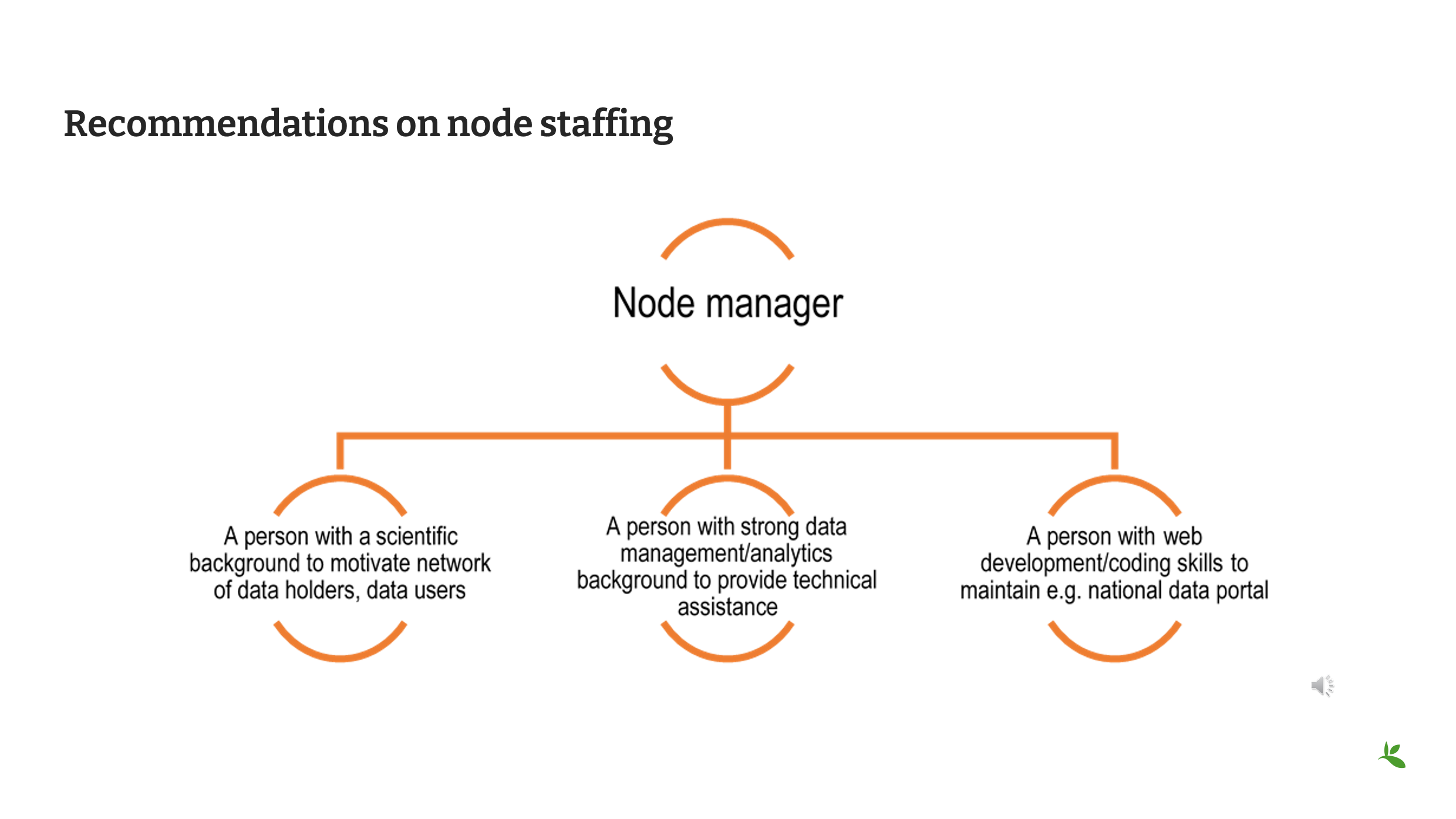
Slide 12 - Recommendations on node staffing
Running a node requires a broad mix of skills.
GBIF’s guidance on establishing an effective Participant node includes suggestions on staff roles within nodes, which includes a minimum of four roles as you see here.
The node manager will lead the team and will serve as the main point of contact with the GBIF network and Secretariat, including participation in the Node Managers’ Committee.
Nodes also benefit from a scientific expert who understands research communities and can motivate and communicate with data holders and users.
Nodes also need a person with skills in data management, to provide technical assistance and maintain databases
And finally, a person with an informatics background to develop and maintain the infrastructure needed for publishing and accessing biodiversity data.
Deciding how to staff a node will, of course, depend on its expected roles, the level of financial support and the hosting agreement or institutional location of the node.
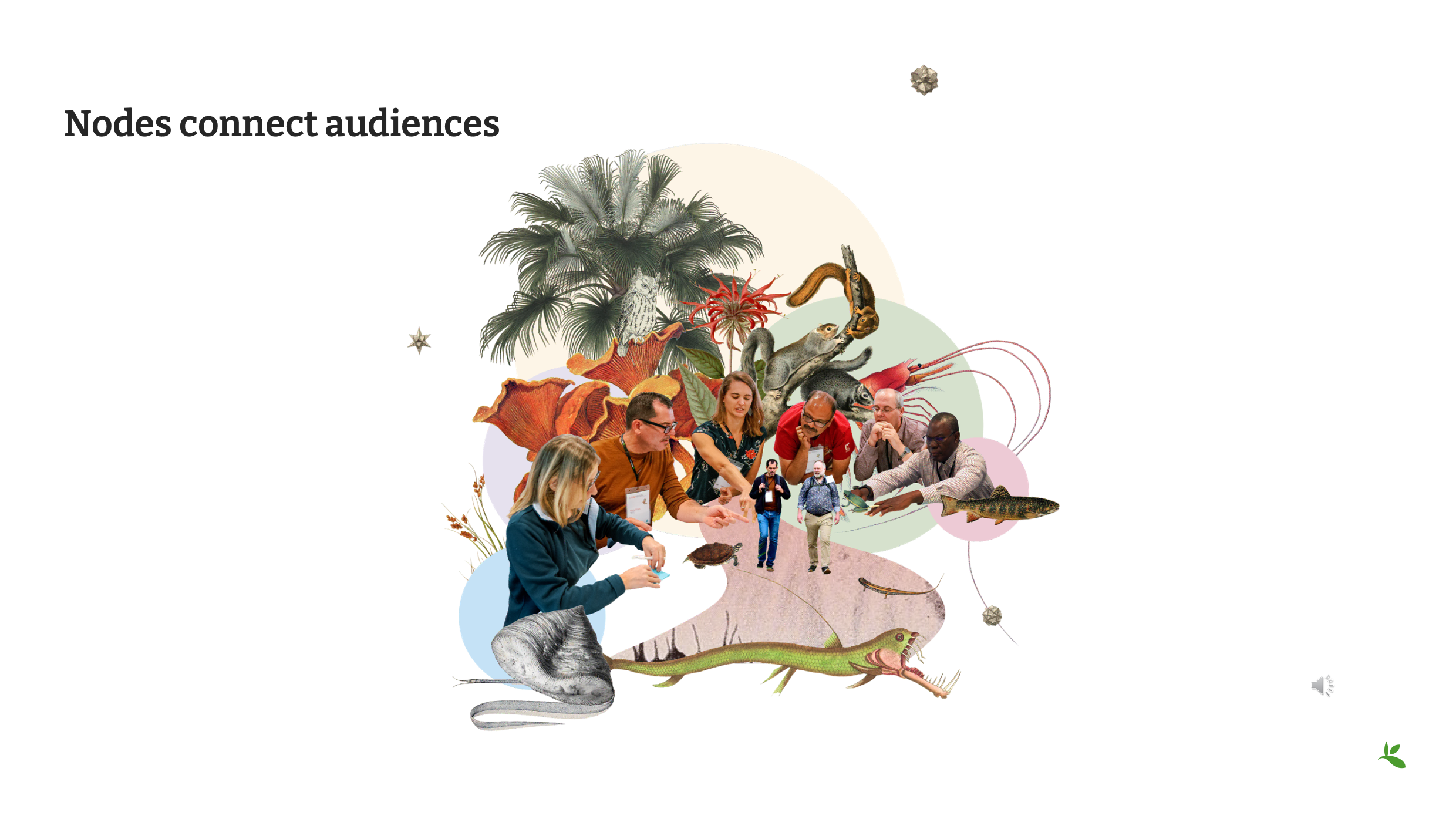
Slide 13 - Nodes connect audiences
In summary, Nodes play an essential role in GBIF’s network and governance.
They connect GBIF’s audiences: people, data, and systems—linking local efforts to a global network.
By supporting data sharing, collaboration, and capacity development, nodes enable both national and international communities to contribute to and benefit from participation in the GBIF network.

第 14 張投影片 - 結論
This video is part of a series of presentations developed for the Introduction to GBIF course. It was created and narrated by me, Melianie Raymond. If you have any questions on the course content, you can reach out at training@gbif.org.
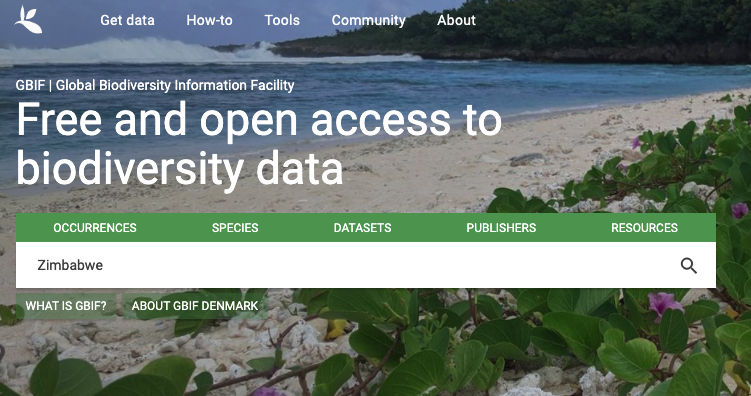
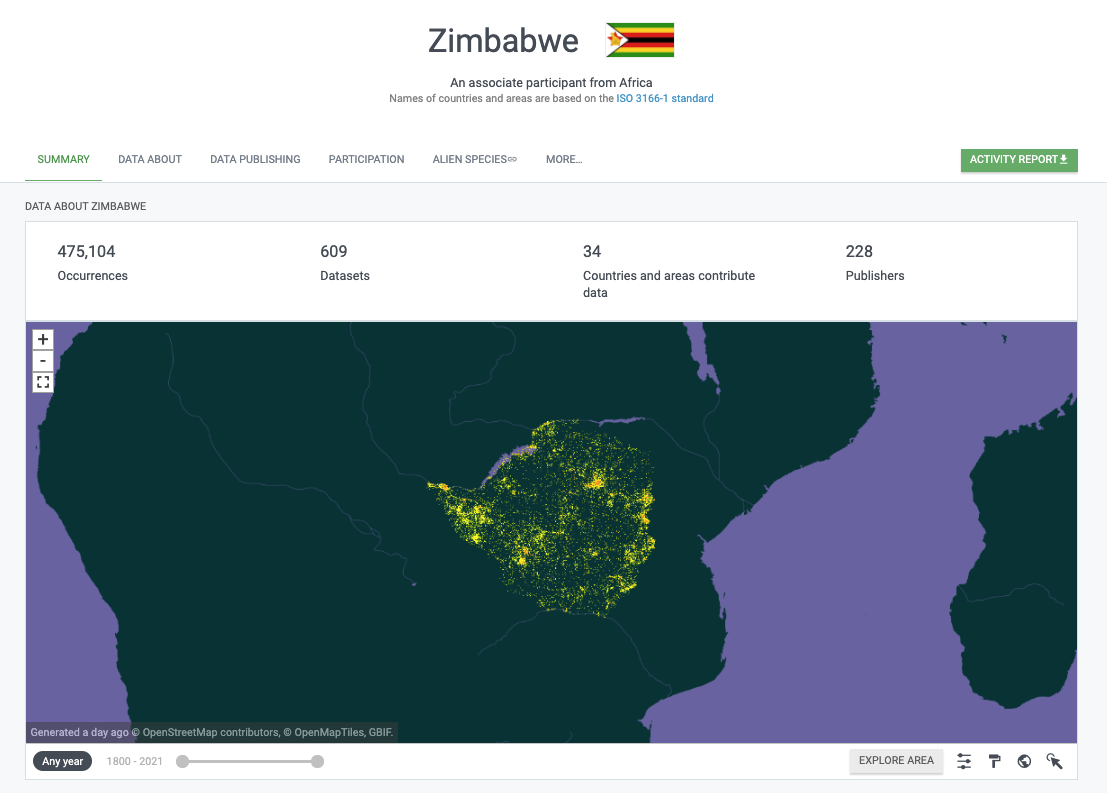
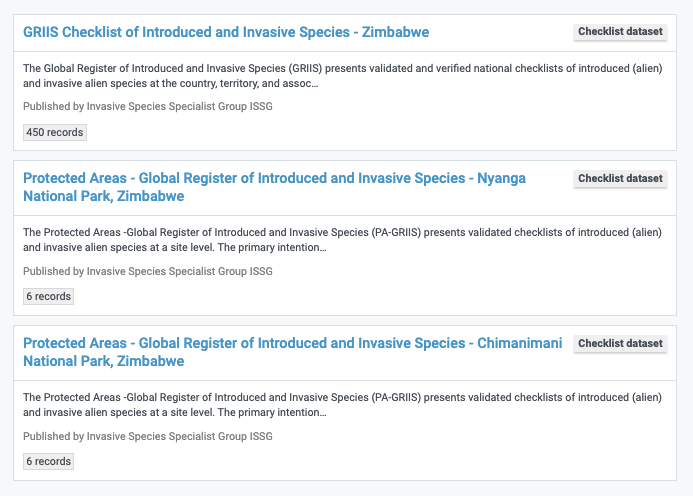
Countries/Economies in GBIF
| Investigate how your country/economy is represented in GBIF |
複習回顧
|
請利用以下測驗評估自己對本單元所涵蓋概念的掌握程度。部分題目可能有多個正確答案。 你可以在 解答附錄 中閱讀更多關於這些答案的詳細說明。 |